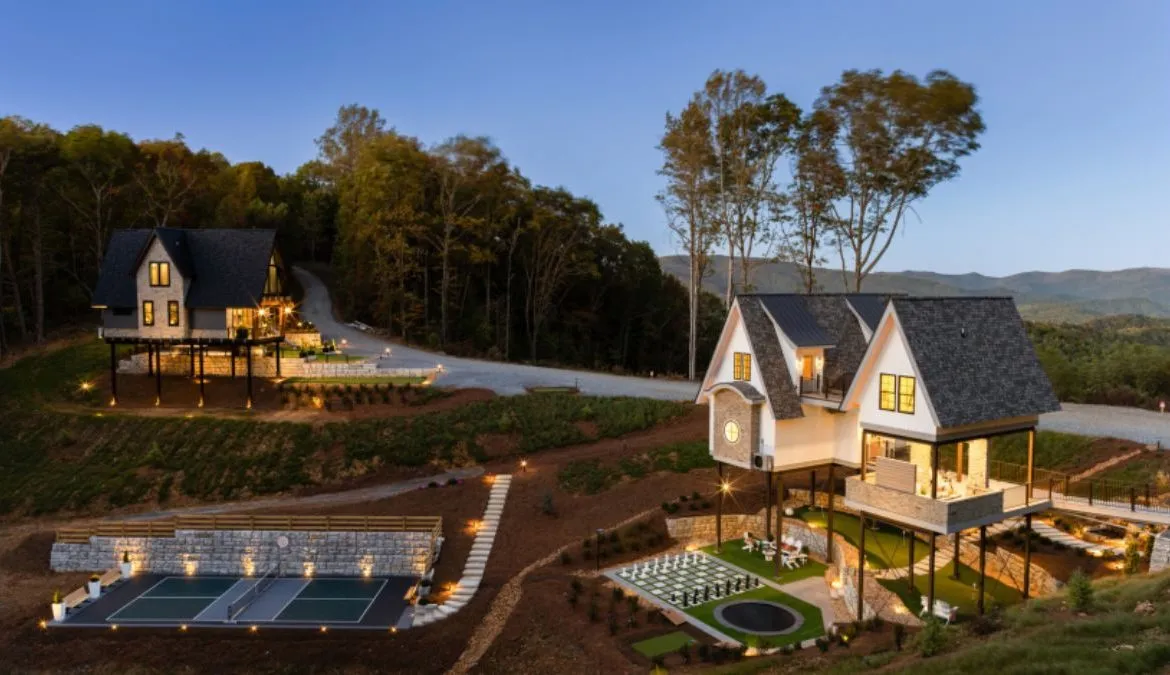
You can build a court on ground that can’t take a concrete slab. Ultra Base panels and a VersaCourt tile surface make that possible over compacted stone, turf and other ground where pouring concrete is impractical. At The Perch at Pinhoti Peak, a mountain retreat designed by Chip Wade, that pairing put a pickleball court over compacted stone on a mountainside, and the same Ultra Base panels also supported the retreat’s turf-covered disc golf tee pads.
This guide explains how the foundation works on difficult ground, what the Perch project needed, and how to judge whether your site is a fit.
Why isn't concrete always the answer?
A poured slab needs ground that is level, reachable and suitable for something permanent. Hillsides, soft ground, tight spaces and areas shared with other uses often fail one or more of those tests.
The real question on such sites is what can go down that still plays like a proper court. That takes a foundation that stays stable on the existing ground, and a surface with consistent ball response and comfort. Modular systems give each job its own layer.
How was a pickleball court built at The Perch?
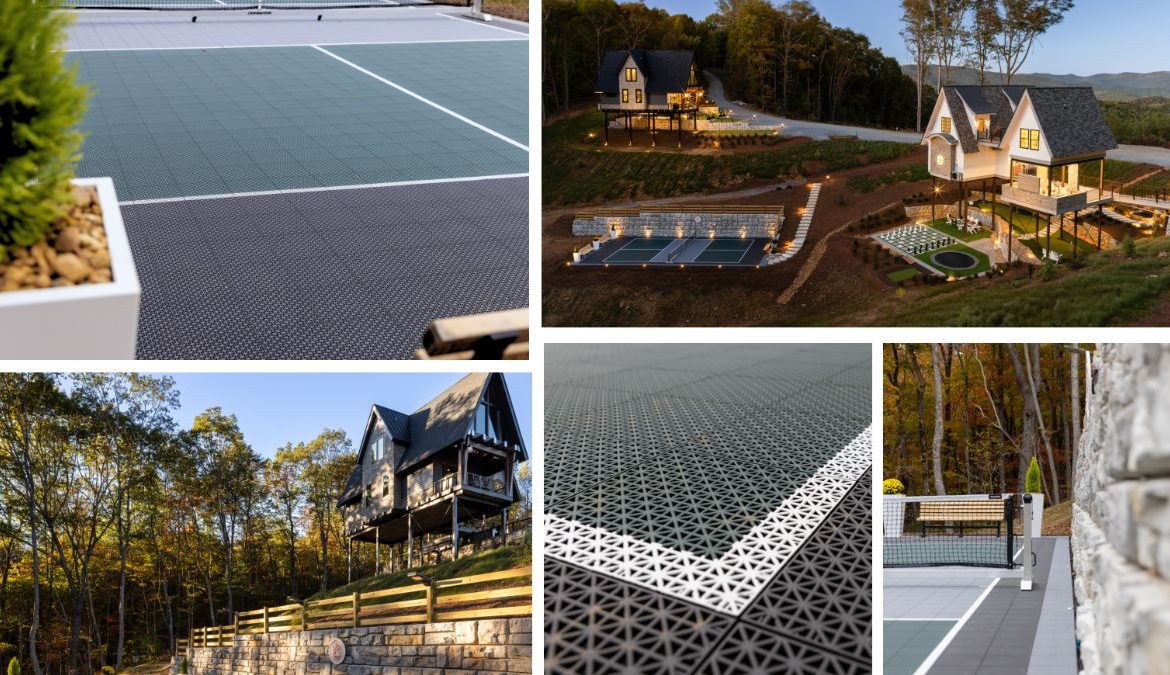
The Perch has three treehouses and outdoor spaces meant to get guests of all ages moving together. The owners wanted a pickleball court in that mountain setting without relying on a traditional poured-concrete slab. It needed to feel comfortable to play on and sit naturally in its surroundings.
- Foundation. Ultra Base Systems panels went over compacted stone. The same system also supported turf-covered disc golf tee pads, so one solution worked across different parts of the property.
- Surface. VersaCourt’s Pickleball Performance tile gave a durable, comfortable surface with consistent ball response.
"Pickleball anyone?! Yep. We somehow managed to excavate a pickleball court on the side of a mountain for The Perch!"
Chip Wade
How does a panel foundation work?
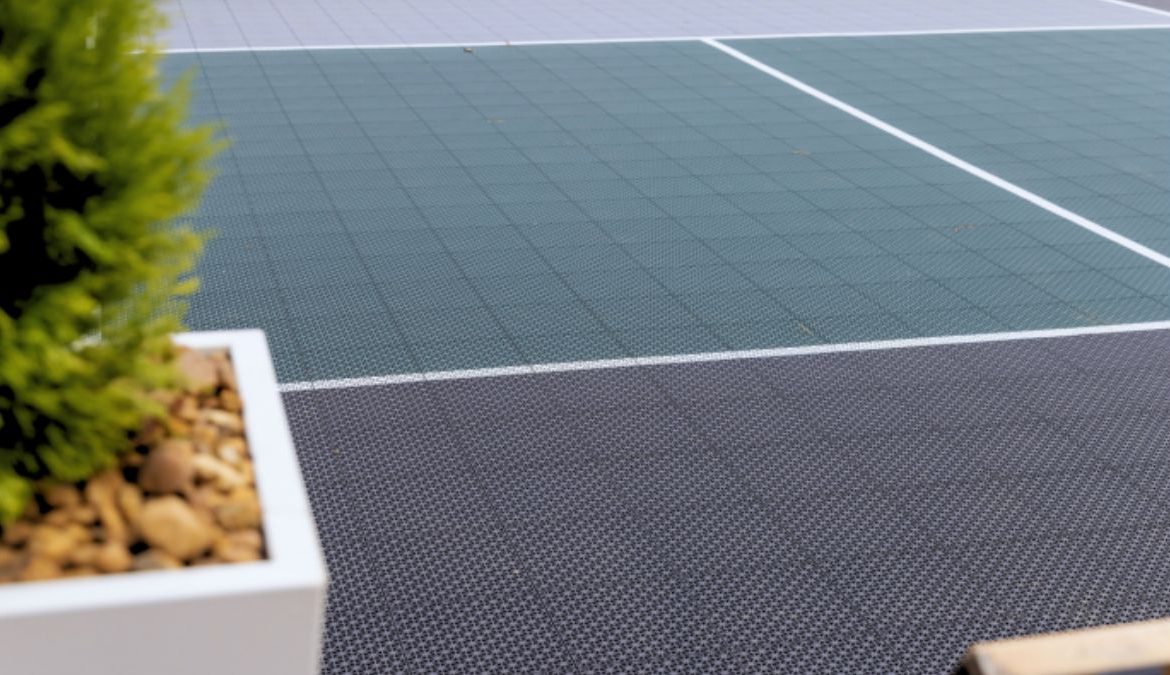
Ultra Base is a foundation system made of interlocking panels. It replaces the concrete or asphalt pad that a VersaCourt tile court would normally sit on. VersaCourt describes it as a permeable sub-base that is ultra-flat and stable, so the court above it plays consistently. The panels are molded from recycled polymers.
The tile court itself is a suspended system, designed to be assembled on a flat, hard subsurface. The panels provide that subsurface where no slab exists. Here is how the layers come together:
- A hard, compact surface. The panels can go directly on any hard, compact surface with a geosynthetic underlayment, according to VersaCourt. At The Perch, that surface was compacted stone.
- Interlocking panels. The panels fit together, with corner and edge pieces to finish the perimeter and an ADA-accessible ramp. The interlocking design allows for thermal expansion and contraction, so the surface doesn’t buckle in extreme weather.
- The tile surface. The VersaCourt tile goes on top and sets the playing feel. At The Perch, that was the Pickleball Performance tile.
Why this suits difficult ground
- It drains. The panels are permeable. VersaCourt lists vertical drainage of 424.5 inches per hour, and horizontal drainage of 12.1 gallons per minute per foot, depending on gradient. Water passes through to the soil below instead of pooling or running off.
- It needs no heavy equipment. VersaCourt says installation requires none, which matters on sites where machinery can’t easily reach.
- It is strong. VersaCourt says the panels are designed to exceed 500 pounds per square inch, and resist cracking and chipping like a concrete base.
- It is fast. In a time trial on a 1,000 sq ft project, UltraBase Systems staff reported about 2.5 hours for panels against 6.5 hours for traditional installation. This is a manufacturer’s own comparison, not an independent test.
The panels are made for a hard, compact surface, not for bare soil. Check ground preparation, slope and drainage with Versacourt before you plan a site.
The same panel approach has been used elsewhere on turf. See how the Toronto Blue Jays built a branded basketball court on a spring training field.
Is your site a good fit?
- The ground is hard to pour on: sloped, soft, remote or hard to reach. (Yes/No)
- You have compacted stone, turf or another base to build over. (Yes/No)
- The space serves more than one use, as the tee pads did. (Yes/No)
- You want a comfortable surface for players of all ages and abilities. (Yes/No)
- You prefer to avoid a permanent slab. (Yes/No)
Ask for a site assessment before committing. Ground conditions, drainage and intended use all affect the base design.
FAQ
Can you build a pickleball court without a concrete slab? Yes. At The Perch, Ultra Base panels over compacted stone served as the foundation, with a VersaCourt Pickleball Performance tile surface on top.
What is Ultra Base? Ultra Base is an interlocking panel foundation. Each panel is 28 x 28 inches installed and 1.25 inches thick, and weighs about 10.2 pounds. UltraBase Systems states a 10-year warranty on the base system.
Can a court be built on a slope or a mountainside? The Perch court was built on the side of a mountain, per Chip Wade. No page gives a numeric slope limit for the panels. UltraBase Systems says the panels flex to follow the natural contours of a slope, and that some installers add steel spikes to stop sliding. That page covers artificial turf, though, not sport courts, and the installation instructions call for a flat or slightly pitched base. Ask Versacourt to assess your gradient.
What ground do I need? The panels need a hard, compact surface. The foundation panel installation instructions say to check drainage and soil, remove organic material such as sod, compact the ground, and add compactable stone if the soil won’t compact. A permeable geosynthetic fabric goes under the base, or an impermeable woven fabric where drainage is poor or the soil expands. The base is graded flat or slightly pitched. The Perch used compacted stone.
Can one foundation system serve different uses? Yes. The Perch used Ultra Base for a pickleball court and for turf-covered disc golf tee pads.
How long does installation take? Versacourt says laying the tile surface can almost always be done within a day, and the base is usually the slowest part. UltraBase Systems claims panels cut installation time by about 40% compared with a concrete pad.