





Home » LED Sports Lighting » LED Baseball Field Lighting: Cost, Funding & Design Guide (2026)


Written By
Ryan Caravalho

Edited By
Antti Rydman

Verified By
Karianne Jaeger
LED Baseball Field Lighting Installation Cost (2026)
This estimate covers recreational ballparks, high school fields, and college baseball stadiums. For professional-level venues, costs can exceed this range due to higher lighting standards, complex layouts, and advanced system components.
The overall construction cost is a function of:
- Required illumination level
- Level of competition
- Product quality
- Size of the field
- Geographical location
LED Retrofit Costs for Baseball Field Lighting Systems (2026)
In many cases, existing light poles can be reused, which significantly reduces overall costs. When only the lighting fixtures need to be replaced and reconnected, the project avoids the high expense of installing new poles or underground wiring.
If you are looking to upgrade your baseball field lighting system to LED, use our baseball field LED retrofit cost calculator to get an accurate cost breakdown for your project.
Expert's Insight
Bill Smith
Bill Smith, President · GeoSport Lighting
In some cases, managers believe it is necessary to replace existing cross arms or poles to upgrade to LED lighting. This is not the case. The best LED systems in the world can be installed on existing poles and cross arms, regardless of the previous supplier of the HID system. These retrofits drastically reduce the upfront cost and allow a far better return on investment for the owner.
LED Baseball Field Lighting Maintenance and Operating Costs
One of the greatest selling points when it comes to LED sports lighting is that you can forget about the hassle of removing and replacing old, burnt-out, lamps. LED lighting fixtures have a very long lifespan compared to conventional HID lighting lamps. – typically somewhere in the region of 50,000 – 100,000 hours!
| High school baseball field LED lighting cost | College baseball field LED lighting cost |
|---|---|
Field size (Sq ft): 105,000 | Field size (Sq ft): 120,000 |
Lux needed: 300-400 | Lux needed: 500-1000 |
LED lumens per watt (LPW): 130 | LED lumens per watt (LPW): 130 |
Wattage needed: 24,000W – 32,000W | Wattage needed: 46,000W – 92,000W |
Avg electricity cost per KWH: $0,12 | Avg electricity cost per KWH: $0,12 |
Operating cost per day (8 hours): $23 – $31 | Operating cost per day (8 hours): $44 – $88 |
Operating cost per month: $690 – $930 | Operating cost per month: $1,320 – $2,640 |
Operating cost per year: $8,280 – $11,160 | Operating cost per year: $15,840 – $31,680 |
Kick Off Your LED Sports Lighting Project
We’ve created a set of tools designed to assist facility managers and project planners in initiating their projects and help connect them with the professionals in the industry.
What Influences LED Baseball Field Lighting Cost?
When buying an LED baseball field lighting system, there are costs for the purchase, shipping or delivery and installation. The operating costs are electricity and maintenance. How much each item ultimately costs depends on various factors.
New installation or LED retrofit?
The cost of upgrading to LED sports lighting from conventional HID lights can vary between $70,000 – $350,000, depending largely on which conversion method you choose between LED retrofitting and replacing the entire lighting fixtures with LEDs. If you opt for a retrofit, you will need to make sure to purchase LED lamps that fit the existing lighting fixture/casing. On the other hand, replacing the old HID lighting fixtures with new LED fixtures will be more labor-intensive and costly, but it will enable you to maximize lighting quality and the benefits that a modern LED lighting system offers.
If you are planning to convert your sports lighting system to LED, use our upgrade to LED baseball field lighting cost calculator to get an instant cost breakdown for your sports facility.
Size of the baseball diamond
As the level of play increases, so does the size of the field. Accordingly, the need for light also increases. The floodlighting system must be precisely matched to the playing field and the requirements of the sports facility operator.
Competition level
The higher the competition level of the baseball club, the higher the demands on the LED floodlight. This is reflected in the purchase price. There is a substantial difference between lighting a high school game and lighting an MLB game.
LED floodlighting or traditional HID lighting?
You have several options for lighting your baseball field. LED is the most affordable option due to its lower power consumption and long fixture life. Savings on energy costs can range from 50-70% compared to HID / metal halide sports lighting, depending on the model.
Read more about what influences LED sports lighting costs in our separate guide.
Regional Baseball Field Lighting Installation Cost Ranges
The cost to install baseball field lighting varies widely across the U.S., influenced by factors such as field dimensions, level of competition (recreational vs. competitive play), required light levels, pole configurations, regional labor costs, electrical capacity, permitting requirements, and local market conditions. The ranges shown below are built from actual baseball lighting projects in our internal dataset, paired with state-specific construction cost index data to reflect regional pricing differences on state and city level. This approach provides a more precise, location-adjusted view to support accurate budgeting.
Browse estimated baseball field lighting costs by state or city, factoring in the key variables that impact total project cost. Select a state/city to view detailed guides, cost breakdowns, and planning insights tailored to your location.
Top Insights:
- Most expensive cities: San Francisco, New York City, Boston, Seattle, San Diego
- Most affordable cities: Jacksonville, Columbus, San Antonio, Indianapolis, Oklahoma City
- Most expensive states: Hawaii, Alaska, California, New York, Massachusetts
- Most affordable states: Mississippi, Arkansas, Alabama, West Virginia, Kentucky
The regional figures below are adjusted from SVC database regional median cost combined with ENR Consruction Cost Index.
Try our baseball field lighting cost calculator to get a tailored cost estimate for your project in two minutes.
Baseball Field Lighting Installation Cost per City
| City | State | Cost Range |
|---|---|---|
| Atlanta | GA | $225,785 – $706,629 |
| Austin | TX | $240,419 – $752,429 |
| Boston | MA | $294,775 – $922,543 |
| Charlotte | NC | $221,604 – $693,543 |
| Chicago | IL | $255,053 – $798,229 |
| Columbus | OH | $204,879 – $641,200 |
| Dallas / Fort Worth | TX | $234,147 – $732,800 |
| Denver | CO | $246,691 – $772,057 |
| Des Moines | IA | $198,607 – $621,572 |
| Houston | TX | $217,422 – $680,457 |
| Indianapolis | IN | $198,607 – $621,572 |
| Jacksonville | FL | $209,060 – $654,286 |
| Los Angeles | CA | $280,140 – $876,743 |
| Miami | FL | $250,872 – $785,143 |
| Minneapolis | MN | $236,238 – $739,343 |
| New York City | NY | $317,771 – $994,515 |
| Oklahoma City | OK | $183,973 – $575,772 |
| Orlando | FL | $219,513 – $687,000 |
| Philadelphia | PA | $255,053 – $798,229 |
| Phoenix | AZ | $227,875 – $713,172 |
| San Antonio | TX | $200,698 – $628,115 |
| San Diego | CA | $284,322 – $889,829 |
| San Francisco | CA | $330,315 – $1,033,772 |
| San Jose | CA | $288,503 – $902,915 |
| Seattle | WA | $223,694 – $700,086 |
| Tampa | FL | $278,050 – $870,200 |
| Washington DC | DC | $278,050 – $870,200 |
Baseball Field Lighting Installation Cost per State
| State | Cost Range |
|---|---|
| Alabama | $183,973 – $575,772 |
| Alaska | $271,778 – $850,572 |
| Arizona | $204,879 – $641,200 |
| Arkansas | $181,882 – $569,229 |
| California | $250,872 – $785,143 |
| Colorado | $219,513 – $687,000 |
| Connecticut | $234,147 – $732,800 |
| Delaware | $213,241 – $667,372 |
| Florida | $209,060 – $654,286 |
| Georgia | $200,698 – $628,115 |
| Hawaii | $282,231 – $883,286 |
| Idaho | $198,607 – $621,572 |
| Illinois | $217,422 – $680,457 |
| Indiana | $196,516 – $615,029 |
| Iowa | $194,426 – $608,486 |
| Kansas | $192,335 – $601,943 |
| Kentucky | $188,154 – $588,857 |
| Louisiana | $192,335 – $601,943 |
| Maine | $204,879 – $641,200 |
| Maryland | $225,785 – $706,629 |
| Massachusetts | $240,419 – $752,429 |
| Michigan | $202,788 – $634,657 |
| Minnesota | $213,241 – $667,372 |
| Mississippi | $179,792 – $562,686 |
| Missouri | $196,516 – $615,029 |
| Montana | $198,607 – $621,572 |
| Nebraska | $190,245 – $595,400 |
| Nevada | $213,241 – $667,372 |
| New Hampshire | $219,513 – $687,000 |
| New Jersey | $240,419 – $752,429 |
| New Mexico | $196,516 – $615,029 |
| New York | $246,691 – $772,057 |
| North Carolina | $198,607 – $621,572 |
| North Dakota | $209,060 – $654,286 |
| Ohio | $198,607 – $621,572 |
| Oklahoma | $190,245 – $595,400 |
| Oregon | $217,422 – $680,457 |
| Pennsylvania | $213,241 – $667,372 |
| Rhode Island | $229,966 – $719,715 |
| South Carolina | $196,516 – $615,029 |
| South Dakota | $192,335 – $601,943 |
| Tennessee | $196,516 – $615,029 |
| Texas | $200,698 – $628,115 |
| Utah | $206,969 – $647,743 |
| Vermont | $213,241 – $667,372 |
| Virginia | $215,332 – $673,915 |
| Washington | $229,966 – $719,715 |
| West Virginia | $186,063 – $582,315 |
| Wisconsin | $204,879 – $641,200 |
| Wyoming | $198,607 – $621,572 |
Baseball Field Lighting Standards and Requirements
The basic unit of light is a lumen. When we talk about lighting requirements, we need to know how the brightness levels over an area some distance from the light source. Knowing how many lumens a lamp puts out isn’t enough. That’s why we talk about lux, the number of lumens per square meter.
As we mentioned earlier, higher levels of play have higher lighting requirements. Professional baseball diamonds need a uniform 1,000 lux at any point on the field: that is, 1,000 lumen per square meter. This requirement gradually reduces down to 200 lux for training facilities and elementary schools.
Baseball Lighting: Classification of Play
| Sports Facility | Class I | Class II | Class III | Class IV |
|---|---|---|---|---|
Illuminance | 100 fc. / 1,000 lux. | 50 fc. / 500 lux. | 30 fc. / 300 lux. | 20 fc. / 200 lux. |
Professional Sports | x | |||
College Sports | x | x | ||
Semi-Professional | x | x | ||
Sports Clubs | x | x | x | |
Amateur Leagues | x | x | x | |
High School | x | x | x | |
Training Facilities | x | x | ||
Elementary School | x |
International competitions and television broadcasts with LED floodlights
When lighting a baseball stadium with LED floodlights, the requirements of the leagues and associations must be taken into account. For example, in stadiums that broadcast games on TV or streaming, camera position must be considered to ensure that all areas are evenly illuminated. This is to avoid shadows and dark spots on the field. Both vertical and horizontal brightness must be increased for 4K and 8k TV broadcast formats.
High school baseball field lighting standards
The size of a high school baseball diamond is around 105.000 square feet depending on how long the distance is from home plate to the outfield fence. High school ballparks usually have the capacity for up to 5.000 spectators. Typically the required lux level for high school diamonds is 200 or 300 lux (20-30 foot candles).
Compared to a collegiate or professional level baseball ground, the lighting requirements at high school level are a lot less strict. This is mainly due to the fact that starting from college baseball level, games are being televised in high definition and this is only possible when the lighting system is up to the required standard.
Infield and Outfield Lighting Requirements
Most of the action, and the most fast-paced action, takes place on the infield. This is where every hit has its maximal velocity, the players’ reaction times are barely in the tenths of a second and umpires and batters need to figure out what to do about one 90+mph pitch after another.
As a result, infields need to be brighter than the outfield. You may have noticed this if you’ve ever been to a competitive baseball game at night. If you sit in the outfield, the infield looks like a stage play, it’s lit so brightly. On the other hand, if you’re sitting behind home plate or along the baselines, it might seem like the outfielders are way out there, back in the shadows. That’s not an optical illusion: there is a difference in minimum light levels, which also explains why the much-smaller infield will be surrounded by the same number of light poles as the much larger outfield.
Recommended Illumination for Baseball fields
| Baseball Class of Play | Lighted area | Lux | Foot candles |
|---|---|---|---|
I | Infield | 1500 | 150 |
Outfield | 1000 | 100 | |
II | Infield | 1000 | 100 |
Outfield | 700 | 70 | |
III | Infield | 500 | 50 |
Outfield | 300 | 30 | |
IV | Infield | 300 | 30 |
Outfield | 200 | 30 |
Little League Lighting Standards and Requirements
Little League fields typically cover a total area of 40,000 sq ft, which is three times smaller than a professional or college stadium, which measures an average of 120,000 sq ft. Additionally, little league games do not require the same level of quality of lighting output compared to the big leagues.
Thanks to the smaller area that needs to be lit and the lower quality requirements, the cost of installing a little league baseball lighting system is also considerably lower.
In the below table, you can learn about the lighting levels and standards for little league baseball lighting systems.
Read more: Little league baseball field lighting guide
| Little League Baseball Lighting | Average Constant Light Levels | Uniformity Ratio: Max to Min | Maximum Rate of Change |
|---|---|---|---|
Infield | 50 footcandles / 500 lux | 2:1 | 10% per 10 feet |
Outfield | 30 footcandles / 300 lux | 2.5:1 | 10% per 10 feet |
Little League World Series Lighting Requirements
If you’re planning on hosting Little League World Series events or televised competitions, the rules for your lighting change slightly.
When planning for broadcast, you may need to increase your footcandles from the standard rule of 50fc in the infield and 30fc in the outfield. Illumination is vital for broadcast, and ensuring your field is lit correctly is critical.
Additionally, the color temperature of your lighting is now a concern. While most little league fields don’t require white light, if you’re planning on being broadcast-ready, your lighting should emit a color temperature of 5700 K and a CRI of 65+. However, it’s best to consult an expert before deciding your field’s color temperature.
A professional sports lighting company understands the requirements and will be able to configure your system to accurately meet the needs of little league players, officials, and fans.
LED Sports Lighting Buyer's Guide
Our comprehensive buyer's guide covers all the essential aspects including budgeting, design, funding, and installation considerations, simplifying your decision-making process.
Get the Free Guide
Baseball Field Lighting Systems Explained
The lighting design ultimately depends on the requirements of the facility. A diamond that is mainly used for training as well as youth and amateur games, for examples, requires less light than a professional or collegiate diamond that has to look good for the cameras on top of the actual sporting demands.
Baseball requires even more attention to lighting concerns because of the size, speed and hardness of the ball. A batter watching a 95 mph pitch cannot afford to lose focus for a split second into the glare or haze of a poorly placed, poorly engineered light. Likewise, an outfielder tracking a pop fly does not want to be watching the ball move from light to shadow to light as he tries to get under it to make the catch.
What kind of baseball field lighting systems are used to light up ballparks?
Nearly all baseball diamonds being built or renovated today are installing LED lights instead of conventional metal halide lamps. This is one part of the game where even traditionalists acknowledge the advantages of new technology!
It’s not just baseball: all sports venues are turning to LED lights. But baseball, in particular, needs to insist on the best quality light. No other sport has a ball so small coming at people so fast from so close a distance – and with minimal protective gear. Glare, haze, or uneven luminance levels can make a huge difference in the quality of play and player safety when the ball is moving nearly 100 mph and the player is trying to see the spin and arc of the ball for a split-second decision from 60 feet away.
LED baseball field lighting system features
Dimming
Adjust the brightness level between 0% and 100% with a click of a button.
No warm-up time
Instant on and off (no warm-up period)
Flicker-free
LEDs maintain a steady lighting output thanks to the high-frequency drivers used by quality sports lighting brands.
Scheduling
Program and schedule the light fixtures to switch on and off automatically at specific times.
Glare control
LED baseball field lights are designed to minimize glare that can be inconvenient and even dangerous during play.
LED Sports Lighting Buyer's Guide
Our comprehensive buyer's guide covers all the essential aspects including budgeting, design, funding, and installation considerations, simplifying your decision-making process.
Get the Free Guide
Choose LED baseball field lighting fixtures
LED baseball field lighting fixtures maybe costlier upfront compared to metal halide fixtures, but they are worth every penny in the long run. Firstly, LED fixtures can save you up to 75% in utility bills and energy consumption. Secondly, you will not have to deal with replacing bulbs and you can expect your LED luminaires to last at least up to 50,000 hours (vs. 10,000 hours for metal halide lamps). LED lighting fixtures are sometimes referred to as LED floodlights, LED high mast lights, or LED stadium lights. They all mean the same thing in the end. The only thing that changes is the potency of the fixtures. Depending on the size of your baseball field and the level of competition, LED floodlight wattage ranges between 400 and 1500 watts.
If your baseball diamond already has a metal halide lighting system installed and you are planning to upgrade it to LED, you can follow these recommendations for conversion:
- A 400-watt LED baseball field light fixture replaces a 1000-watt metal halide sports lighter.
- A 600-watt LED baseball field light fixture replaces a 1500-watt metal halide sports lighter.
- A 1000-watt LED baseball field light fixture replaces a 2000-watt metal halide sports lighter.
Examples of LED baseball field light fixtures
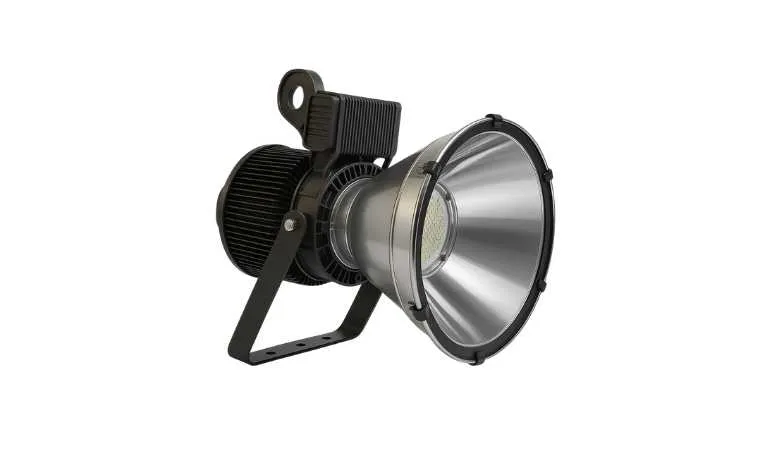
LED Baseball Field Floodlight Fixture
- Mounting height: 30 – 100+ feet
- Wattage: 300W – 1000W
- Beam angle: 15 – 90 degrees
- Best for: Baseball and softball fields, especially outfield pole lighting
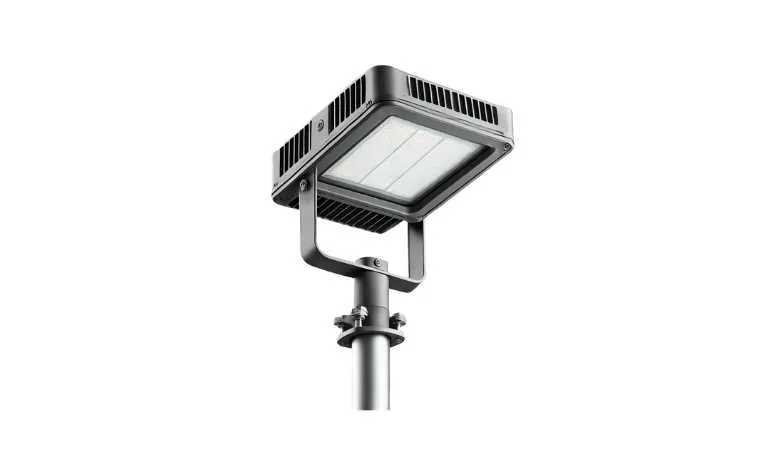
LED Shoebox Fixture for Baseball
- Mounting height: 25 – 40 feet
- Wattage: 200W – 600W
- Beam angle: Type III, IV
- Best for: Practice fields, secondary areas, parking/auxiliary zones
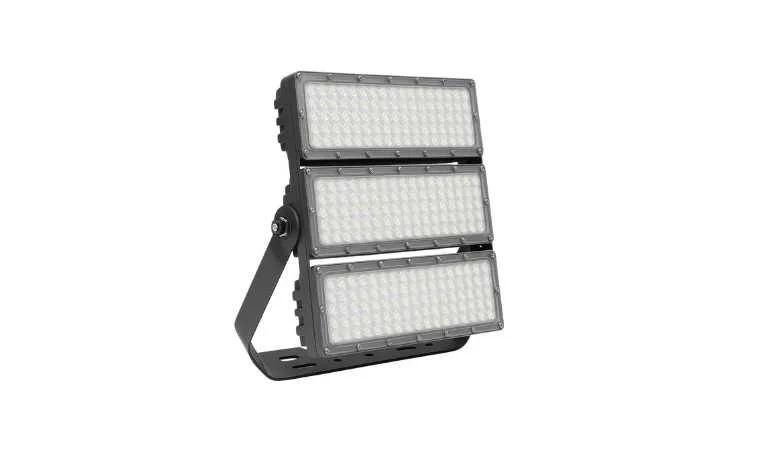
LED Modular Floodlight for Baseball
- Mounting height: 40 – 100+ feet
- Wattage: 400W – 1800W+
- Beam angle: 10 – 120 degrees
- Best for: Stadiums, high competition level, TV broadcast
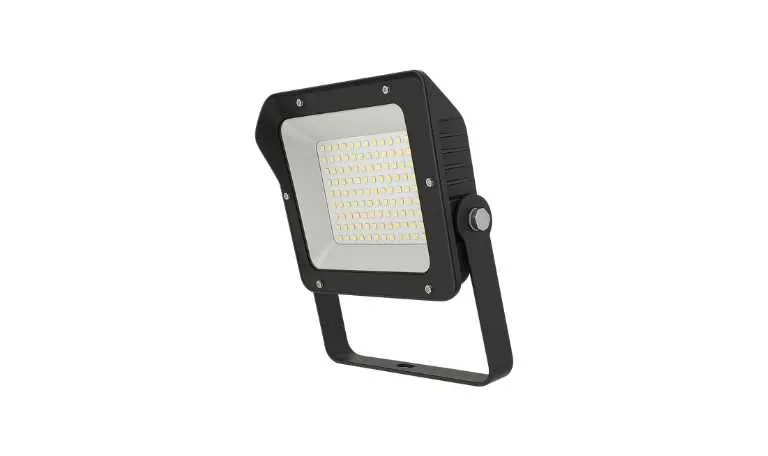
LED Asymmetric Floodlight for Baseball
- Mounting height: 30 – 60 feet
- Wattage: 300W – 1000W
- Beam angle: Type III, IV, V optics
- Best for: Perimeter-mounted poles, reduced glare and light spill
Baseball Field Lighting Design and Layout Guide
Proper lighting is critical for safe and enjoyable play on any baseball field, whether it’s for Little League or professional use. Lighting design begins with understanding the field’s dimensions, which directly influence the lighting layout and coverage. Key considerations include how many light poles are needed, where they should be placed, and how many fixtures each should support to achieve even illumination. A well-planned pole arrangement helps minimize shadows and glare, enhancing visibility for players and spectators alike. Finally, a photometric study is essential to model light levels across the field, ensuring the design meets performance and safety standards.
1. Baseball field dimensions
The shape and size of the baseball field can have a big impact on your lighting system design and layout. To ensure the safety of the players and provide an optimal viewing experience for the fans in the stands, the lighting system has to be designed and installed according to the dimensions of the field.
- Overall area of the field: The bigger the baseball diamond, the higher the lighting poles must be, the more lighting fixtures you will need, and the more potency/output per luminaire is required.
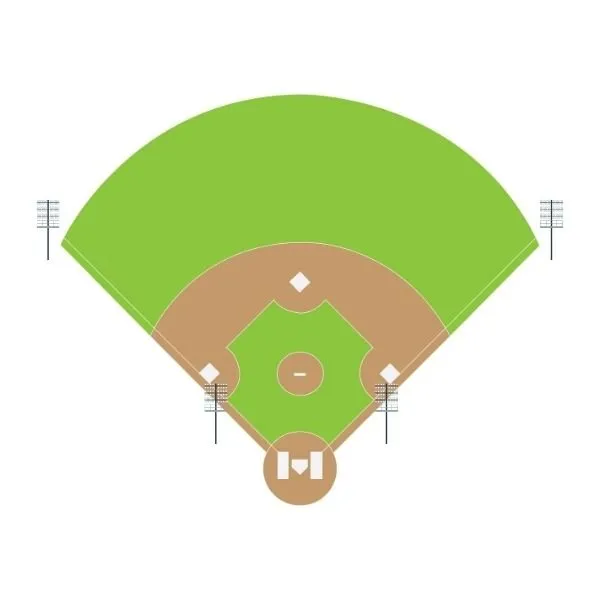
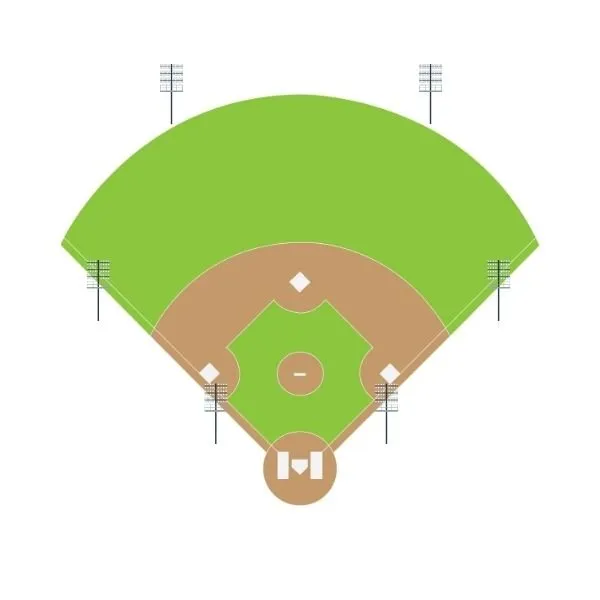
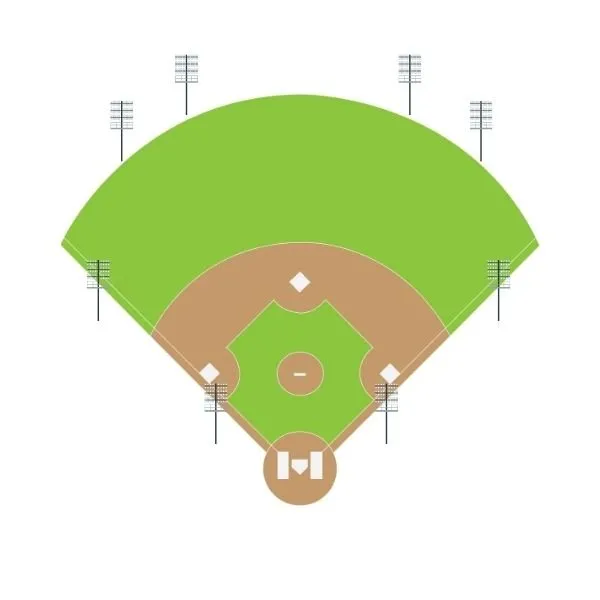
- Distance to the home run fence and from the foul lines to the field: The longer the distance from the home base to the fence, the more lighting output is needed. You will have to consider whether to install 4, 6, or even 8 lighting poles to reach the lighting levels and uniformity needed for your facility. Additionally, the closer your foul lines are to the field, the further away you will have to place the lighting poles.
2. Baseball field lighting layout and light pole arrangement
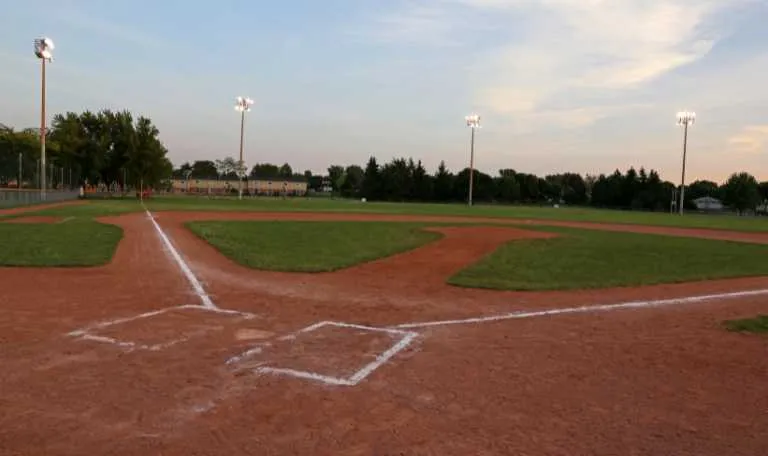
Baseball diamonds that only need four light poles place two on either side of home plate, and one just outside of and slightly behind the foul poles. As the diamond expands at the high school, college and minor league levels, those latter two poles are brought towards home plate and are just past the plane of first base and third base. Then, two additional poles are placed behind right-center field and left-center field.
For diamonds that need maximal lighting due to their size and competitive requirements, two more lights are added in the outfield, just inside the foul poles. That brings the total to four light poles around the perimeter of the outfield, and four staking out the infield.
These arrangements ensure uniform lighting plus player-friendly sightlines. When the batter has his eyes locked on the pitcher’s delivery, the outfield lights are far enough away and high enough that he won’t be looking into a face-full of light. And the infield lights are outside of his field of view, behind him and to the sides. Similarly, the lights closest to the outfielders are behind them. When they look up into the night sky for a pop fly, they won’t have the lamps or hazy glare interfering with their ability to spot the ball.
The size of the diamond affects the height of the light poles as well as their number. Little League and rec diamonds will have 40-50′ poles, while professional ballparks will need 100-180′ poles. At the higher levels of play, the players’ sightlines (how high the batters will hit the ball affects where the fielders will be looking), the size of seating area and the amount of illumination required by the league and broadcasters all go into determining how tall the poles should be.
3. How many baseball field lighting fixtures and poles do I need?
The number of light poles around a baseball diamond comes down to the size of the field and the amount of light needed for games at that level. A Little League diamond has less space and lower lighting demands, so four light poles are sufficient. High schools, colleges, and the lower rungs of the minor leagues can make do with six poles; while the big leagues and their farm teams need eight or more.
A simplified calculation for the number of lighting fixtures needed for a baseball field:
The number of LED baseball lighting fixtures needed to illuminate your baseball diamond depends on the size and the competition level of the facility.
The bigger the total area that needs to be lit, the more lighting output and wattage are needed to reach the required lighting levels.
A full-sized, collegiate or professional level baseball field size is 120,000 square feet, whereas, a high school baseball field is a little bit smaller (105,000 square feet).
- LED baseball field light fixture lumens per watt: 140
- Footcandles needed:
- High school: 30 fc.
- College/Pro: 100 fc.
- Total lumens needed:
- High school: 3,150,000 lumens
- College/Pro: 12,000,000 lumens
- Total wattage needed:
- High school: approx. 22,500 watts
- College/Pro: approx. 85,700 watts
- Number of baseball field lighting fixtures needed:
- High school: 23 x 1000w LED fixtures
- College/Pro: 43 x 2000w LED fixtures
Why You Need a Photometric Study for Baseball Field Lighting
Planning your baseball field lighting project is a big step—but even with a solid plan, poor lighting performance after installation can be a costly setback. That’s why a photometric study is a must.
Lighting professionals use CAD software to simulate how your lighting system will perform based on field dimensions, pole height, fixture specs, and beam angles. This ensures your design meets IES standards before any hardware goes up.
The photometric report typically includes:
2D footcandle (fc) grid
3D renderings of light distribution
Light level summary (min, max, avg)
Uniformity ratios
False-color heatmaps
Fixture and pole specs
Before committing to a lighting installation, request a photometric study from a trusted U.S. sports lighting provider. It’s the best way to avoid surprises and ensure a field that’s game-ready from day one.
Photometric study example for a high school baseball field
Here’s a sample photometric study for a high school (Class III) baseball field, following IES lighting standards. While not intended for permitting, it gives a clear look at how lighting professionals design for performance and coverage.
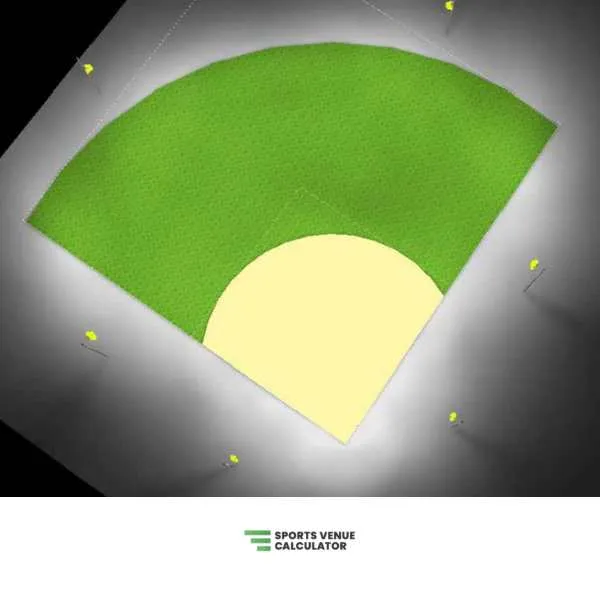
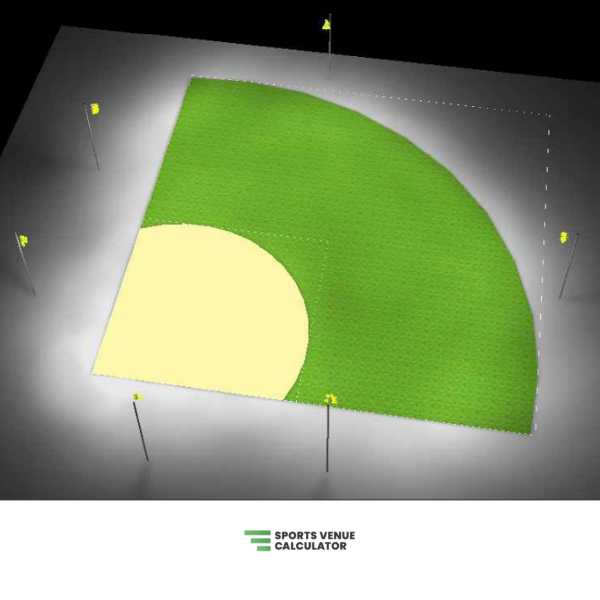
3D Visualizations of the Lighting Layout
The 3D renderings offer a realistic view of the lighting setup, showing light pole placement, fixture heights, and how light is distributed across the field. It’s a helpful way to visualize beam angles, coverage zones, and overall system design before installation.
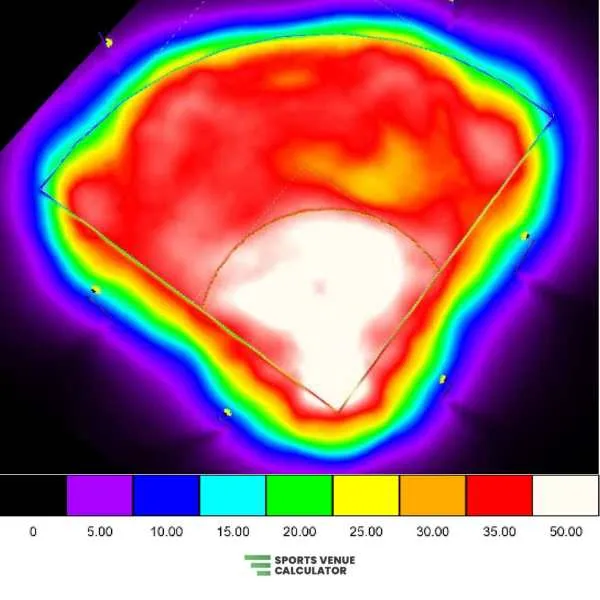
False color rendering (lighting heatmap)
This image is a false color rendering—also known as a lighting heatmap. It uses color gradients to show how light levels vary across the baseball field, with warm colors indicating brighter areas and cool colors showing dimmer zones. It’s a quick, visual way to evaluate light distribution and uniformity.

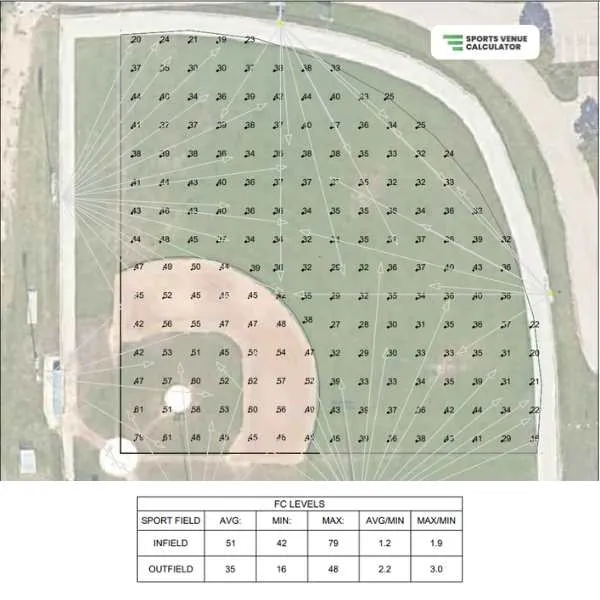
Designing the right lighting setup
A photometric study helps engineers choose the best fixtures for the field—factoring in wattage, lumen output, mounting height, and how many lights are needed to meet required levels.
In the example below, the lighting design is based on those calculations to ensure proper coverage and performance.
- 30 x 600W LED light fixtures, mounted at 70 feet (beam angle: 15 degrees)
- 30 x 600W LED light fixtures, mounted at 67 feet (beam angle: 30 degrees)

Other important LED baseball field lighting considerations
Because the light that LED lamps emit does not scatter, lighting designers can guarantee uniform lighting across the playing surface in a way they never could with metal halide lamps.
Color temperature
Color temperature refers to the “warmth” or “coolness” of light, measured in Kelvin (K). This concept comes from the way a “black body” (a theoretical object) would glow if heated to various temperatures. For example, at 2500 K, the light emitted would appear orange, while at 4000 K, it would be yellow. As the temperature increases, the light shifts to whiter and eventually to blue hues. If you’ve seen the blue flame of a gas stove, you’ve witnessed this effect.
It’s important to note that “warmer” light in this context actually corresponds to lower color temperatures, while “cooler” light corresponds to higher temperatures.
For outdoor sports lighting, cooler temperatures in the range of 5000K to 6000K are generally recommended. These produce a bright, white light that closely resembles daylight, ensuring excellent visibility and accurate color rendering for both players and spectators. This range is also ideal for televised events, as it enhances color accuracy and clarity on screen.
While warmer lights (2000K-3000K) create a more natural and cozy atmosphere, they are typically better suited for environments like homes or restaurants rather than sports venues. Warmer lights may make it harder to see fast-moving action clearly, which is why cooler, whiter lights are preferred in sports settings.
In summary, while warmer lights offer a comfortable ambiance, cooler lights are essential for ensuring the best visibility and experience in outdoor sports venues.
The beam angle and projection angle
The beam angle and projection angle of a lighting fixture ensure that as much light as possible goes where you want it: onto the field, uniformly.
If these factors are not set appropriately, some of the light will be wasted. Some will go into the stands, some will go into the sky and some will go into areas that are already well-lit, making one patch of the field too bright and another too dark.
These angles also affect the sightlines of the players. If the angle is suboptimal, players may have to look straight into light during the course of play – something we want to avoid and can avoid through proper design and installation.
How to turn on and operate baseball field lights?
Turning on the lights at your baseball diamond is as easy as turning on a light switch. It could even be easier than that: it could be a matter of a few taps on an app on your phone.
LED lighting systems are simple to control and extremely flexible. Many systems come with software that allows the user – facilities managers, team coaches, team staff – to control which light fixtures are on, the brightness and warmth levels of each and even the movement of the lights (e.g., a light show when announcing the lineups or during the 7th inning stretch).
This is one more area in which LED sports lights are more cost-efficient than halide lamps. Halide lamps usually required a staff member on-site to turn them on and off; needed 10-15 minutes to warm up; and were “all or nothing.” Each of those factors costs money. With a smartphone-controlled LED system, the coach can turn on just those lights he needs at the start of practice and shuts them off when everyone has left. No extra staff, no extra electricity.
Definitely easier than turning a double play.
Among the many things baseball purists lament about the modern game is the standardization of baseball diamond dimensions. The distance between the pitcher’s mound and home plate, the height of the mound and the distance between the bases – 60′ for little league, 90′ for high school and above – have always been fixed. But part of the charm of the sport and the challenge of being a batter or outfielder is the amount of leeway diamond designers had when laying out the outfield fence. Few outfields – even in the major leagues – would be a perfectly smooth, geometrical curve. There’d be sharp turns, discontinuities and multiple corners. A flyball that would be a home run in right field would be an easy out if it with the same power and angle to left field. Hitters preferred some ballparks, outfielders preferred others.
Baseball diamond designers still have some flexibility, if they choose to use it. For example, for colleges and any level of pro play, the distance from home plate to each foul pole needs to be at least 325 feet, and the longest point to centerfield – in line with home plate and second base – has to be at least 400 feet. From there, feel free to be creative – and don’t forget fence height!
Baseball diamonds that only need four light poles place two on either side of home plate, and one just outside of and slightly behind the foul poles. As the diamond expands at the high school, college and minor league levels, those latter two poles are brought towards home plate and are just past the plane of first base and third base. Then, two additional poles are placed behind right-center field and left-center field.
For diamonds that need maximal lighting due to their size and competitive requirements, two more lights are added in the outfield, just inside the foul poles. That brings the total to four light poles around the perimeter of the outfield, and four staking out the infield.
These arrangements ensure uniform lighting plus player-friendly sightlines. When the batter has his eyes locked on the pitcher’s delivery, the outfield lights are far enough away and high enough that he won’t be looking into a face-full of light. And the infield lights are outside of his field of view, behind him and to the sides. Similarly, the lights closest to the outfielders are behind them. When they look up into the night sky for a pop fly, they won’t have the lamps or hazy glare interfering with their ability to spot the ball.
The size of the diamond affects the height of the light poles as well as their number. Little League and rec diamonds will have 40-50′ poles, while professional ballparks will need 100-180′ poles. At the higher levels of play, the players’ sightlines (how high the batters will hit the ball affects where the fielders will be looking), the size of seating area and the amount of illumination required by the league and broadcasters all go into determining how tall the poles should be.
The number of light poles around a baseball diamond comes down to the size of the field and the amount of light needed for games at that level. A Little League diamond has less space and lower lighting demands, so four light poles are sufficient. High schools, colleges and the lower rungs of the minor leagues can make do with six poles; while the big leagues and their farm teams need eight or more.
Nearly all baseball diamonds being built or renovated today are installing LED lights instead of conventional halide lamps. This is one part of the game where even traditionalists acknowledge the advantages of new technology!
It’s not just baseball: all sports venues are turning to LED lights. But baseball, in particular, needs to insist on the best quality light. No other sport has a ball so small coming at people so fast from so close a distance – and with minimal protective gear. Glare, haze or uneven luminance levels can make a huge difference in quality of play and player safety when the ball is moving nearly 100 mph and the player is trying to see the spin and arc of the ball for a split second decision from 60 feet away.
Because the light that LED lamps emit does not scatter, lighting designers can guarantee uniform lighting across the playing surface in a way they never could with halide lamps.
LED lights can also provide the appropriate “warmth” of light. Light warmth refers to the light that would be given off by a “black box” heated to various temperatures. If the “black box” is at 2500 Kelvin, it glows orange. At 4000 K, it glows yellow. As you keep raising the temperature of the black box, it starts emitting darker and darker shades of blue. If you’ve ever used a natural gas stove with the flickering blue flame, you’ve seen this sort of thing in action.
Light warmth, then, has nothing to do with how warm the lighting fixtures get while they are on. In fact, it’s actually a bit backwards: the “warmer” the light, the lower the temperature it corresponds to.
Oranges and yellows in the 2000K – 3000K range are very warm, and are best for outdoor usage. They give the most naturalistic and easy-on-the-eyes feel. That makes them ideal for viewers at home and in the stadium. By being closer to natural light, they come across much better on video than colder lights.
Colder lights, on the other hand, are stark and white, sometimes with that blue tinge. These are the kind of lights you’ll probably come across at doctor’s offices or “cubicle farm” offices. Not a very warm and inviting environment, unlike a sports venue!
The beam angle and projection angle of a lighting fixture ensure that as much light as possible goes where you want it: onto the field, uniformly.
If these factors are not set appropriately, some of the light will be wasted. Some will go into the stands, some will go into the sky and some will go in areas that are already well-lit, making one patch of the field too bright and another too dark.
These angles also affect the sightlines of the players. If the angle is suboptimal, players may have to look straight into a light during the course of play – something we want to avoid and can avoid through proper design and installation.
Why You Should Consider LED Lighting for Your Baseball Field
1) LED floodlights do not dazzle
For spectators, it is annoying to be blinded by the floodlights. For players, it can affect their performance and be extremely dangerous if they can’t follow the ball’s trajectory accurately. Glare-free LED lights create a trouble-free sports experience for everyone involved.
2) Light does not flicker
A flickering light can also impair vision, or even be mistaken for a ball moving at high speed in the air against a darker background. .
3) Correct illumination of the diamond
Depending on the game, the requirements of the lighting system for the baseball diamond may vary. The higher class the game, the more lux (foot candles) are usually required. Therefore, it’s better to over-plan than under-plan. But be careful! The lux number should not be much higher than is actually needed, because this will result in additional costs for the floodlight system.
4.) Avoid light pollution!
An optimally adjusted LED floodlight system is “light efficient”: it provides all the light the field needs without wasting any light. In other words, the light is adjusted precisely so that only the desired playing areas of the sports facility are illuminated, and not adjacent areas. This also prevents residents or motorists from being distracted or annoyed by a hazy glow around the stadium.
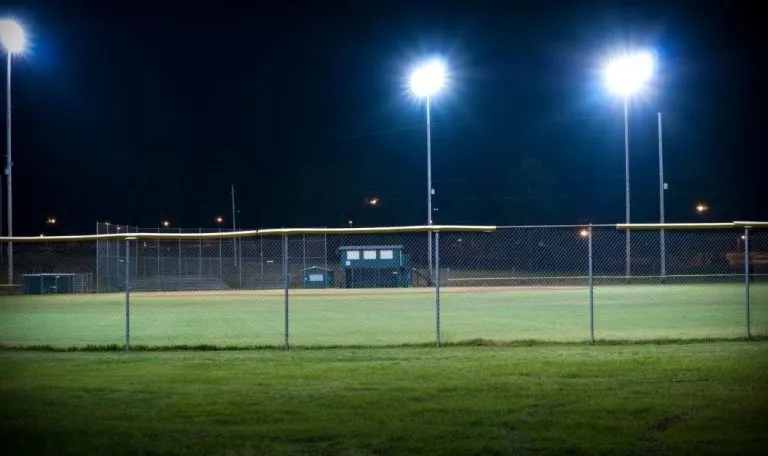
How to Retrofit Your Baseball Field Lighting System with LEDs
LED technology is the future of sports lighting due to the above mentioned reasons. It is also hard to ignore the fact that sports facilities operating LED sports lighting systems save somewhere between 50% to 75% in electricity cost annually. Schools or sports complexes interested in converting to LED should first get an audit from a professional sports lighting company to understand which parts of the existing lighting system can be reused.
It is also highly recommended to get an understanding of the overall costs of a LED retrofit for a baseball field. Our cost calculator makes it very simple and easy. You can get a customized cost estimate in a matter of minutes showing you a detailed breakdown of the costs involved.
Many times only the lighting fixtures need to be replaced, by geting rid of the old HID luminaires and retrofitting new LED fixtures. This is the fastest and cheapest way of doing a retrofit for a baseball field. Sometimes the existing lighting system is too old and new LED lighting fixtures are not compatible with it. In this scenario the LED retrofit project would entail replacing all, or some of, the existing lighting system infrastrucure.
Conversion table: HID to LED baseball lighting
| HID fixture wattage | LED fixture wattage | Energy savings |
|---|---|---|
500 W | 60 – 125 W | 50 – 75% |
750 W | 200 – 400 W | 50 – 75% |
1000 W | 250 – 500 W | 50 – 75% |
1500 W | 400 – 750 W | 50 – 75% |
2000 W | 500 – 1000 W | 50 – 75% |
LED Baseball Field Lighting: Grants & Funding
An LED floodlight installation enhances a sports field and increases the number of hours it can be used. For this reason, such an installation usually finds many supporters.
To help with funding, explore the possibility of obtaining lighting grants from federal and state funds, as well as from the municipality.
Another option is fundraising. This is a way to raise funds from businesses and individuals. It is also advisable to involve club members or students and parents. Creative projects can generate revenue that can be used to purchase the facility.
Baseball Field Lighting Companies
Companies specializing in sports lighting solutions can assist in installing or retrofitting LED sports lighting for your baseball field. These firms possess expertise in designing and implementing lighting systems tailored to sports venues, ensuring optimal illumination for both players and spectators. They consider factors like light uniformity, glare reduction, and energy efficiency. Additionally, many of these companies offer advanced control systems, allowing for easy management of lighting conditions. Whether you’re upgrading an existing system or installing a new one, it’s crucial to engage a company with a track record in sports lighting to guarantee the best results for your baseball field.
Pro tip: If you are currently looking for a reliable and knowledgeable sports lighting vendor, try our sports lighting partner finder and get connected with suitable lighting partners.
Kick Off Your LED Sports Lighting Project
We’ve created a set of tools designed to assist facility managers and project planners in initiating their projects and help connect them with the professionals in the industry.
LED Baseball Field Lighting Q&A
Baseball fields commonly use high-intensity discharge (HID) lighting, specifically metal halide lamps. However, LED lighting is becoming increasingly popular due to its energy efficiency, longer lifespan, and better light control. LED lights offer improved visibility, reduced glare, and lower maintenance requirements compared to traditional HID lighting.
Baseball field lights are typically tall poles or structures that provide adequate illumination across the playing area. For recreational fields, heights range from 30 to 50 feet. Higher-level stadiums can have poles ranging from 60 to 100 feet or more. The taller height minimizes shadows and ensures uniform lighting for optimal visibility. Consult local guidelines for specific height requirements.
The control panel for LED baseball field lights serves as the central command center of the lighting system. Typically situated in a secure location, it offers various controls for managing the lights. These controls may include switches for light activation, allowing for brightness adjustment and timer settings. Advanced systems often incorporate digital touch screens, enabling convenient operation and may even provide remote control capabilities or integration with smartphone apps. To ensure safety, the control panel is equipped with features like circuit breakers to safeguard against electrical faults. Regular inspections are essential to verify the control panel’s optimal functionality.
Baseball field lighting has evolved over time. In the 1930s, carbon arc lamps were used for the first lighting systems, enabling night games. In the 1960s and 1970s, metal halide lamps became available, providing brighter and more uniform lighting. The recent revolution in baseball field lighting occurred in the 2000s with the emergence of LED sports lighting technology. LED lights offer energy efficiency, longer lifespan, and improved visibility for players and spectators.
The buzzing sound is commonly associated with older lighting systems, such as metal halide or high-pressure sodium lamps.
Baseball field lights may buzz due to factors such as ballast operation, vibrations, or loose components. LED lighting systems, which do not require ballasts, have reduced or eliminated this buzzing sound.
Meet the SVC Experts
Written by: Ryan Caravalho, Contributing Author
Ryan Caravalho has been writing for Sports Venue Calculator since 2022, specializing in clear, research-driven content for sports facility planners. With a background in tech, F&B, non-profits, and NGOs, he brings a broad, practical perspective to early-stage sports construction projects.
Read more from Ryan.
Edited by: Antti Rydman, Managing Editor
Antti Rydman is a Co-Founder and the Managing Editor of Sports Venue Calculator. A member of the founding team, Antti has led editorial operations since 2021, shaping the platform’s content strategy and overseeing its growth as a trusted resource for sports facility planning and construction.
Read more about Antti.
Verified by: Karianne Jaeger, Construction Project Manager
Karianne Jaeger is a Project Manager with 16 years in commercial construction, specializing in sports facilities. At Beaver Construction Consulting Inc., she partners with architects, engineers, and city planners to ensure smooth permitting, compliance, and project delivery.
Read more about Karianne.