The Question Behind Pivot Performance Turf
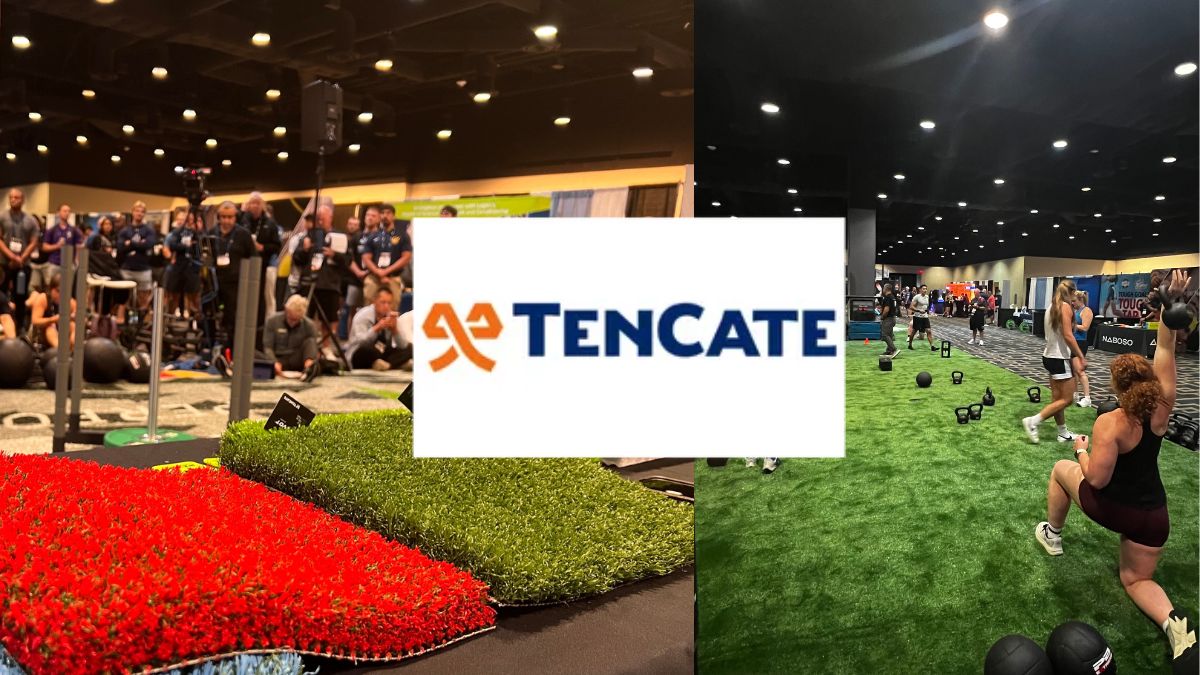
Turf performance is usually judged by how it holds up over time. TenCate is asking a different question: how does it feel to the athlete moving across it, rep after rep? At the National Strength and Conditioning Association’s 2026 National Conference in New Orleans (July 8-11), TenCate presented its case to a room full of strength and conditioning coaches, researchers, and performance staff. The pitch was simple. If coaches are already tracking how athletes move, adapt, and fatigue, that same data should inform what’s under their feet.
That thinking sits behind Pivot Performance Turf, TenCate’s newest system. Rather than relying only on standard field testing, TenCate built Pivot around data collected from more than 1,000 college and professional athletes wearing movement sensors during training. The goal was to understand how the surface actually responds during starts, stops, cuts, and landings, not just how it performs in a lab.
One notable design choice: Pivot skips rubber infill entirely, using a fiber-based construction instead. TenCate says removing loose infill cuts out a variable that can make a field’s response less predictable under repeated use, which matters most when athletes are running the same movements hundreds of times across a season.
What TenCate’s Leadership Is Saying
“The more we understand how athletes interact with the field, the better we can design surfaces around real movement,” said Joe Fields, CEO of TenCate Americas, on the shift toward research-driven surface design.
Colin Young, Ph.D., TenCate’s Chief Technical Officer, framed it as a complement to existing methods: standard turf testing still matters, but athletes bring information that instruments alone can’t capture, namely how a surface actually feels mid-movement.
What This Means for Facility Planners
For facility planners and athletic directors evaluating turf systems, the takeaway is that surface selection is increasingly a performance and injury-prevention decision, not just a durability or budget one. As more manufacturers lean into athlete-tested design data, expect surface specs to become a bigger part of the conversation early in project planning, not an afterthought at the procurement stage.