A new recycling partnership between TenCate Americas and Triton Group could keep up to 21 million pounds of synthetic turf plastic out of landfills
What happens to a synthetic turf field when it wears out? A new partnership announced on October 20, 2026 offers one answer: it becomes part of a railroad track. TenCate Americas and Triton Group will convert plastic recovered from retired turf fields into composite railroad ties. iSustain, which brought the two companies together, is also a party to the agreement.
The numbers
Triton is building the capacity to process up to 350,000 pounds of recovered turf plastic per month. At full utilization, that adds up to 21 million pounds over five years, roughly the amount recovered from 600 to 800 turf fields. It would be enough to make more than 300,000 composite ties.
For an industry that has long struggled with what to do at the end of a field’s life, that is a meaningful outlet. Triton’s leadership sees it as a demand problem rather than a supply problem:
“The problem in this industry has never been supply. It has always been demand,” said Greg Janson, President and CEO of Triton Group. “The Triton Tie creates the demand for challenging material like synthetic turf. TenCate has material that needs a solution, and we have a product and a process that provides it. That is what makes this work. The turf comes to us at the end of its useful life on the field, and it leaves here as a railroad tie that will be in the track for decades.”
What the Triton Tie is
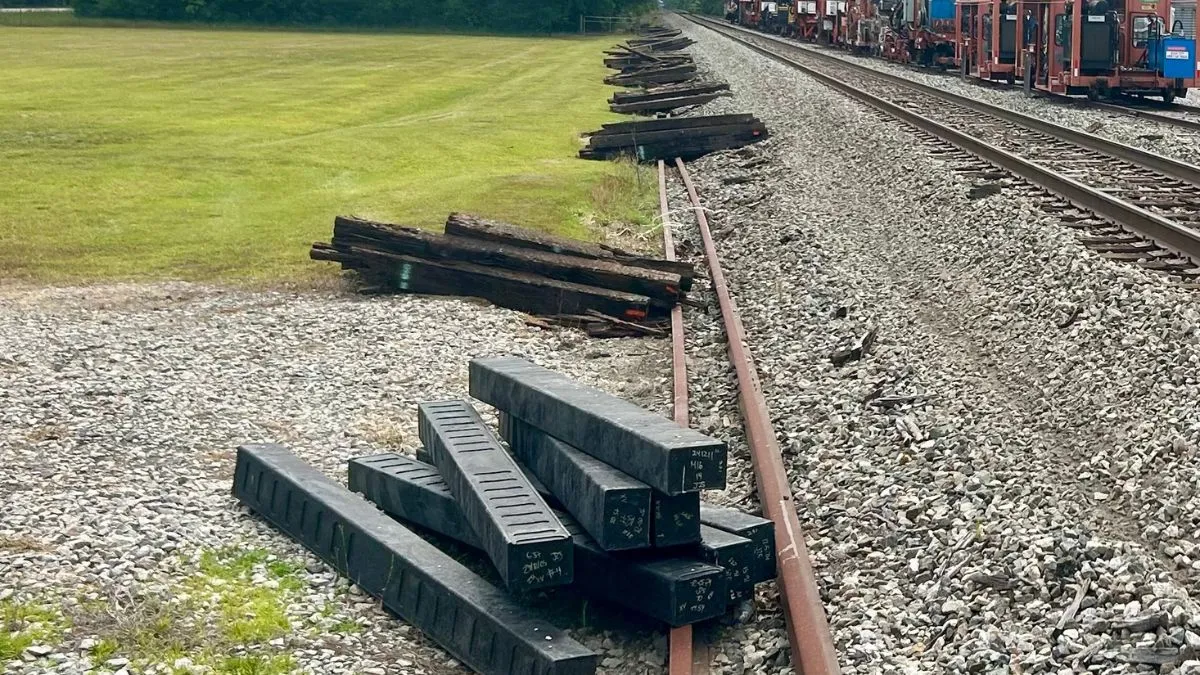
The Triton Tie is a glass fiber-reinforced composite tie designed as a one-for-one replacement for wood. It meets or exceeds AREMA standards and has been approved by all major railroads in the U.S. Plastic from retired turf will be one of its key ingredients.
Composite ties also remove the need for creosote, the chemical used to protect wood ties from decay, and they spare mature hardwood trees. If 300,000 wood ties were replaced with composites, that would avoid nearly 1 million gallons of creosote and keep roughly 75,000 hardwood trees standing.
How the process works
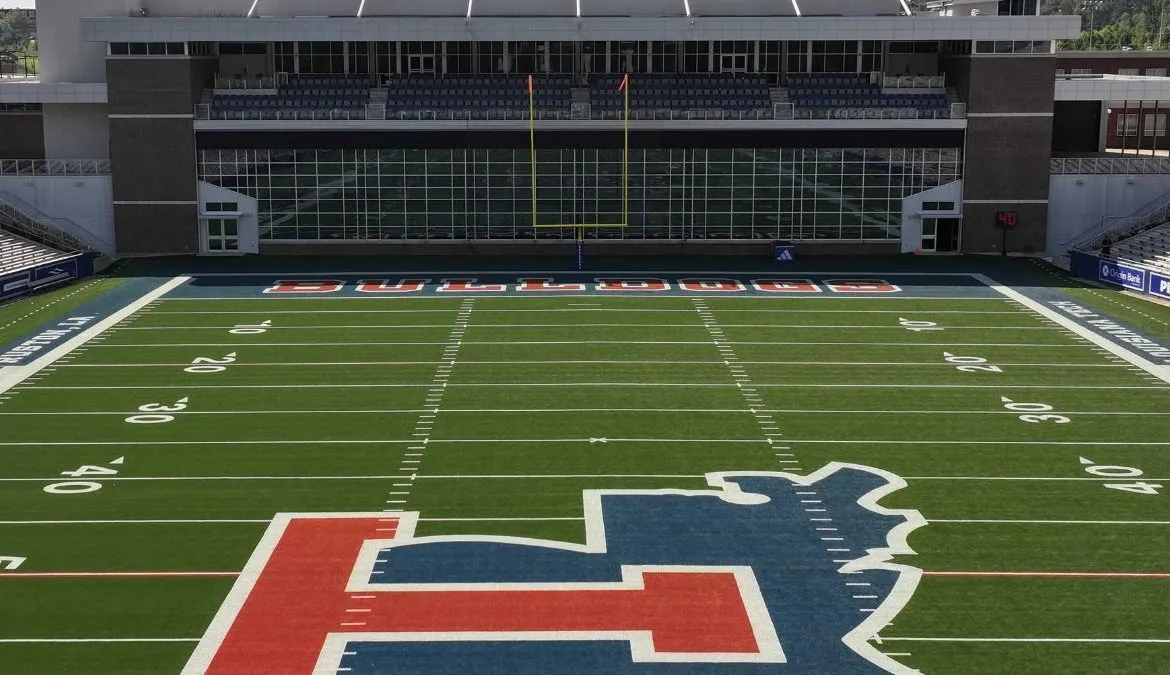
TenCate will recover material from retired fields, separate the sand and rubber infill from the turf, then bale the turf and ship it to Triton. Triton then uses a proprietary process to turn it into a consistent post-consumer resin built for durable applications like the tie.
Triton is targeting April 1, 2027 to start processing TenCate material, once a new production line is complete. On what ends up in the finished product, Janson was direct:
“We are putting in equipment specifically for this material,” Janson said. “One hundred percent of the residual rubber, sand, and backing is removed by our process before anything is pelletized. What we use in the tie is clean polyethylene resin. No rubber enters the tie. We want to be clear about that.”
TenCate’s recovery approach
For TenCate, this is one of several recovery routes. The company already recovers rubber infill from retired fields for reuse and keeps testing recycled material in new turf. It has set up mechanical recycling relationships in Europe and is building that capability in the U.S.
Joe Fields, CEO of TenCate Americas, describes the partnership as part of a longer-term effort:
“Every generation of turf should be better than the last, including what happens when it’s time to replace it,” Fields said. “That means reusing recovered rubber, exploring how recycled material can go back into new turf and finding other uses for recovered plastic. Triton gives us another strong option and another way to keep those materials in use.”
The role of iSustain
iSustain helps companies find recycling and material recovery opportunities. It connected TenCate with Triton and is a party to the agreement.
“Recycling works when recovered material has a reliable end market,” said Mark Huber, Vice President of iSustain. “We recognized the opportunity to connect TenCate’s recovered turf with Triton’s composite railroad ties. By bringing these companies together, we helped create a practical, scalable pathway that transforms a challenging material into durable infrastructure.”
Janson closed with a line that sums up the deal:
“When the end market works, recycling works,” Janson said. “That is the whole idea, and this agreement is what this looks like in practice.”
Planning a turf field?
If you’re planning a new synthetic turf field or replacing an existing one, ask your supplier what happens to the old surface. To learn more about TenCate Americas and its approach to turf design and end-of-life recovery, visit tencategrass.us.