SMG Sportplatzmaschinenbau GmbH has been building machines for synthetic sports surfaces since 1975. The company designs and manufactures its entire range at a single site in Vöhringen, Germany, covering the installation, maintenance, and removal of artificial turf fields and running tracks. In 2025 SMG opened its first direct North American subsidiary in Dalton, Georgia, replacing a third-party distributor arrangement with local staff, a certified workshop, and a parts warehouse. Machines are still built in Germany, but the people who service them are now based in the United States.
Why Sports Field Machines Matter To A Facility Owner
Equipment tends to enter the conversation twice: when a contractor arrives on site, and when something has already gone wrong with the surface. Most of the money gets lost in between.
Synthetic turf surface warranties are almost never unconditional. Manufacturers set out maintenance requirements covering grooming frequency, infill redistribution, and decompaction, and they expect those tasks to be documented. When a claim is filed on a field showing compaction or infill migration, the first question is what maintenance was performed and with what equipment. A field groomed with improvised or undersized equipment can fail that test even when the owner believed the field was being properly cared for, because the manufacturer is not assessing intent. They are assessing whether the specification was met.
So equipment selection is not purely a contractor decision. It protects an asset that typically costs several hundred thousand dollars and is expected to last eight to twelve years.
"If you fall behind on maintenance, you're dealing with compacted surfaces, drainage issues, accelerated wear on a field. You spend more money at the end trying to revive it than you would to maintain it correctly."
Dustin Bradley, Turf Supervisor & Technician, SMG
Origins: Fifty Years In Vöhringen
SMG was founded in 1975 and has spent its entire history in one specialized field. The company was an early developer of machinery for laying synthetic surfaces, and by the 1980s it had introduced some of the first purpose-built maintenance machines for artificial turf with granulate infill. Around 55 people work at the Vöhringen site, and the company reports a global base of more than 1,200 customers served through its own operations and a network of sales partners.
The range covers mixing and paving machines for in-situ elastic layers and running tracks, filling and infill equipment, cutting and line tools, more than twenty maintenance and cleaning machines from handheld units to ride-on models, and a group of machines built for removing and reclaiming end-of-life turf. SMG works directly with surface manufacturers so its maintenance machines meet their care specifications, alongside the relevant sports governing body standards.
What Single-Site Production Means For An Owner
Keeping development and manufacturing in one location has a direct effect on the numbers an owner cares about, and parts continuity is the clearest example. A machine bought today can be supported across its full service life because the company that designed it still builds it in the same place, using the same supply chain and the same engineering records. That is not a given in a market where equipment is often assembled from sourced components by a brand that may not exist in a decade. It matters most for machinery expected to stay in service for many seasons. This is equipment that will still be in use through the surface’s next replacement cycle, not specific to a replacement schedule.
Rebuildability follows from the same logic. Machines built to be serviced can be repaired instead of replaced, and worn components can be renewed rather than written off. Resale and trade-in value hold up as a result, which pulls down the real cost of ownership over time.
From Vöhringen To North America
Machines are built in Germany and shipped to the United States on a regular schedule. The Dalton operation receives both new and refurbished units, and accepts trade-ins from customers upgrading their equipment.
New inventory moves by sea freight roughly monthly, and by air freight weekly, keeping the pipeline of machines and their parts steady without relying on costly last-minute shipping. The goal behind it is to keep a full inventory in North America, not just of machines but of the parts that support them, so a facility’s timeline depends on what’s already in Dalton rather than on a shipment still crossing the Atlantic.
Dalton, Georgia: What Local Presence Changes
SMG chose Dalton for a specific reason. The region is the center of the United States synthetic turf industry, which puts the company close to the manufacturers, the contractors, and a large share of the country’s installed fields. Machines arrive from Germany weekly to keep new inventory stocked, alongside refurbished units and trade-ins.
The shift from distributor to direct subsidiary changes what happens when a machine stops working. Local staff carry the manufacturer’s own product knowledge rather than representing a catalog of unrelated brands. A certified workshop handles service and repairs in Dalton, GA. A parts warehouse holds everything from nuts and bolts to wheels, seats, and screed bars, so common replacements ship domestically instead of crossing the Atlantic.
The parts operation runs on a simple process. A customer calls or emails with a machine down, identifies the part by picture or by name, and Lisa, who manages parts and shipping at the Dalton warehouse, locates it in the schematics, pulls it from the shelf, packs it, and ships it.
"My turnaround time is pretty fast. From email to shipping is usually within the hour," she says.
Lisa Bradley, Office Administration, SMG
Anything not held in Dalton ships directly from Germany, by air when the situation calls for it. Stock levels are set ahead of each season based on what came up the year before, including the rare failures, so that the next facility with the same problem is not waiting on a transatlantic order.
Repairs follow the same logic, with the machine coming to the parts rather than a technician going out to the machine.
"It's actually more economical for customers to send their equipment to us here in Dalton. That way I have parts readily available. If I'm out somewhere troubleshooting something, we'll have to wait on parts to be overnighted. It's better to have the equipment brought here, and we have testing procedures that we do."
Roger Dupree, Technical Service Manager, SMG
For a grounds department working around a tight event schedule, that is the difference between a lost week of bookings and an afternoon of downtime.
The Product Range
Turf and track are different businesses with different buyers, so it is worth taking to them separately.
Artificial turf
Installation
Filling equipment determines how a new field performs. The SandMatic and Spreader units distribute sand and rubber infill evenly, and the OscillatingBrush works the material down into the fibers. Sport Field Builders operate these machines on projects, as well as Sport Field Managers who are responsible for maintaining their own sport field surfaces after installation for preventative maintenance.
Maintenance
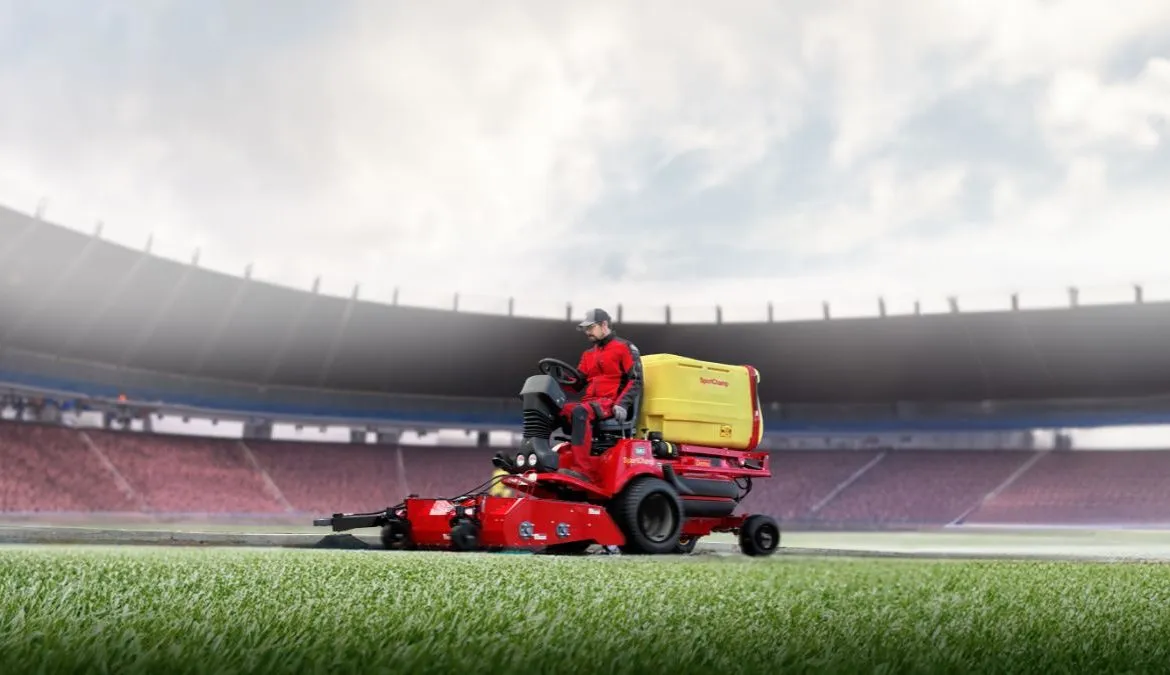
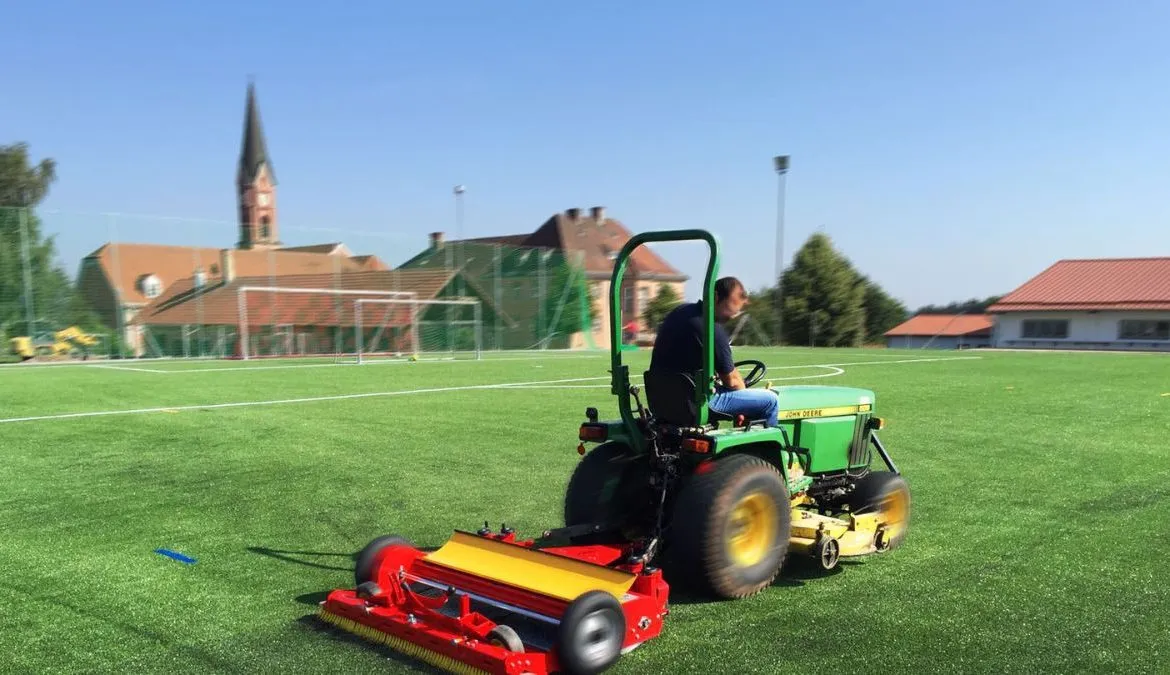
This is where most owner purchasing decisions sit, and matching the machine to the facility matters more than buying the largest machine available. The range runs from triangle brushes and ground driven tow behind machines like the TurfCare for routine grooming up to ride-on machines like the SportChamp, which grooms, decompacts, and lifts debris in a single pass.
"A TCA 1400 or 2000 is a great tool for a collegiate athletic field, for a municipality field, for a private school, really for any field. It's an all-purpose machine, a groomer and a sweeper at the same time. Time is limited for a field manager, and you have a lot of other responsibilities. Grooming a field, then sweeping a field, then tining a field, that's three times. With our machines you can get it done essentially once."
Steve Pizzi, General Manager, SMG
What a facility needs depends on its square footage and the human resources available to maintain the surface.
Reclamation
When a synthetic turf field reaches the end of its useful life, the turf must be removed and the existing infill properly managed. SMG TurfMuncher machines are designed to efficiently separate and recover infill during the removal process, while complementary cutting, lifting, and winching equipment helps remove and roll the turf for disposal, recycling, or potential reuse.
For facility owners planning a future field replacement, this stage should be considered well in advance. Removal, infill recovery, transportation, and disposal can represent a significant portion of the overall replacement cost and are often underestimated during initial budgeting. Having the right equipment and removal strategy can reduce labor, improve material recovery, and make the entire replacement process more efficient.
Running tracks
Construction
Track equipment is contractor territory. MixMatic mixers process granulates and binders, PlanoMatic pavers lay elastic base layers and surfacing, and StrukturMatic and GranuMatic machines apply the structural spray coats that give a track its textured, non-slip finish. SMG states the range covers everything from playgrounds through to IAAF-certified stadiums.
Renovation
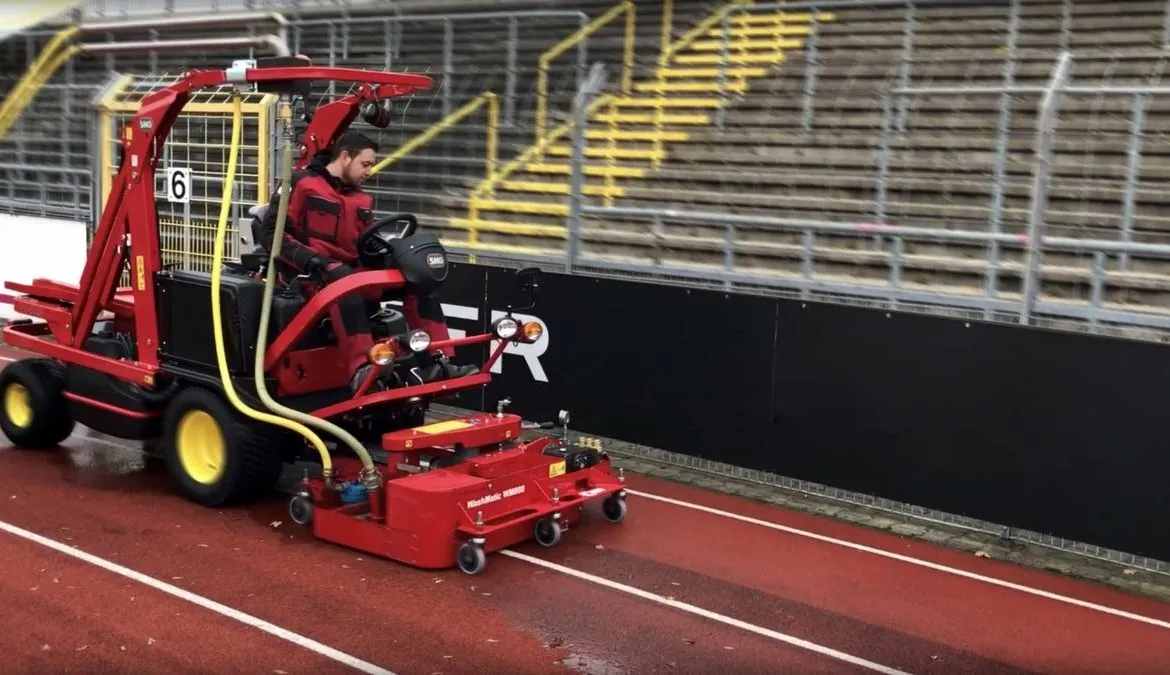
Tracks are resurfaced rather than replaced. RauMatic and RotoMatic milling and grinding machines strip worn surfaces so the track can be renovated. For an owner, this is worth understanding at the budgeting stage, since resurfacing arrives on a predictable cycle.
Buy, Contract, Or Share
The buy-versus-contract decision usually comes down to cost, control, and documentation.
Contracted maintenance is an annual operating expense that recurs for the life of the field and rises with labor costs. Equipment is a capital purchase that holds residual value and can be traded in against a replacement. Across a typical field lifespan, the crossover point arrives sooner than most budget models assume, and it arrives sooner still for facilities running heavy event schedules that require more frequent attention than a standard service contract covers.
Control is harder to put a number on. A contractor works to a schedule that serves their route, not the facility’s calendar. Owners with in-house equipment groom after a tournament weekend, before a championship, or when the weather finally allows. For facilities with heavy event usage, responding immediately after an event rather than three weeks later is what separates a surface that recovers from one that compacts.
Documentation is the quiet one. Owning the equipment makes it straightforward to keep a consistent maintenance record, which is exactly what a manufacturer asks for when a warranty claim is filed.
For districts and municipalities managing several sites, a shared equipment model spreads the cost across facilities. One machine serving multiple schools or parks under a shared maintenance program brings the per-field cost down substantially while keeping the work in-house, and it builds internal capability instead of a dependency on external scheduling.
After-Sales, Service, Warranty, And Training
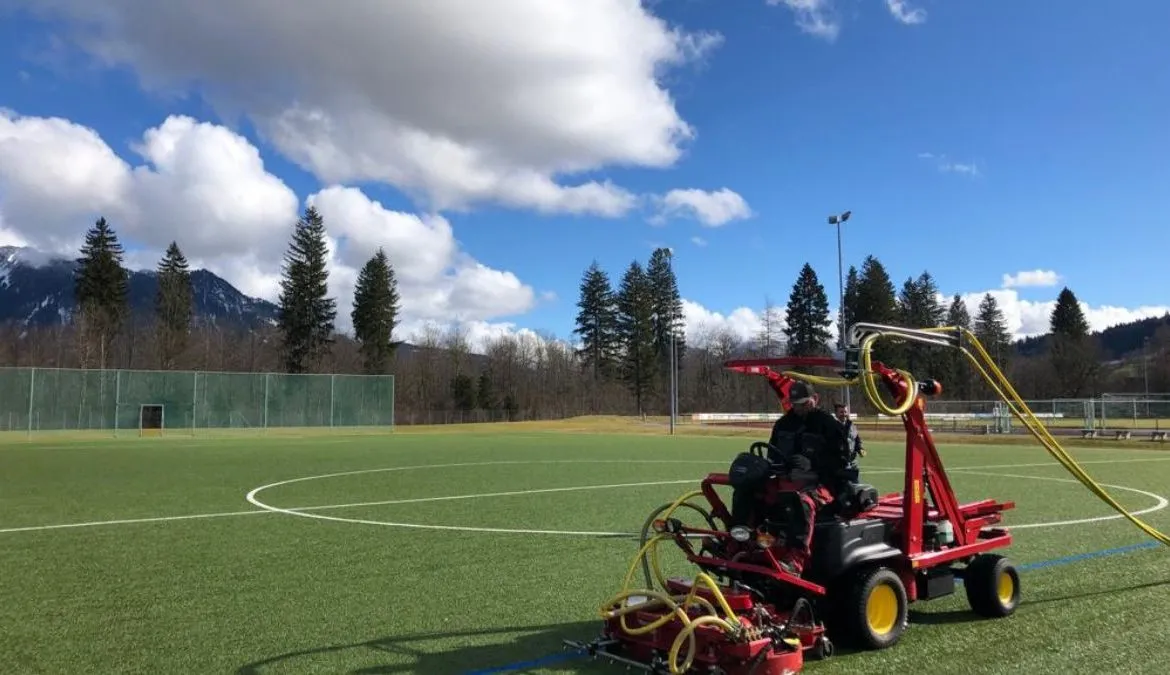
SMG Machines covers its machines for one year from delivery. What shapes ownership over the long run is the support behind the machine purchase, and that is what the Dalton operation was built to provide. The parts warehouse carries everything from small hardware to major components, so common replacements ship domestically instead of waiting on Germany. The certified workshop handles diagnosis, repair, and refurbishment on site. The team knows the product line rather than a catalog of unrelated brands.
Training belongs in the same category and is the piece facilities skip most often. Groom at the wrong depth or move infill in the wrong direction and a diligent maintenance program still ends with a compacted field. Having people nearby who can show a crew how the machine is meant to be run protects both the equipment and the surface.
"If you buy a piece of equipment from us and you never ran it, I would come to your first job site and spend the day with you to show you how to run it, how to take care of it, and what parts you would need to keep as an emergency."
Dustin Bradley, Turf Supervisor & Technician, SMG
Frequently Asked Questions
Where are SMG machines manufactured, and does that affect parts availability in North America?
All SMG machines are designed and built at the company’s site in Vöhringen, Germany. Since the opening of the Dalton, Georgia subsidiary, commonly needed parts are held in a United States warehouse and ship domestically, and a certified workshop in Dalton handles service and repair work locally.
Does a school district or municipality need its own turf grooming machine, or is hiring a maintenance contractor enough?
Both approaches work, but ownership becomes more attractive as the number of fields increases and as event usage rises. Districts managing multiple sites often find that a single shared machine covering several fields costs less over the life of the surfaces than recurring contracted service, while also giving grounds staff control over timing.
What is the realistic lead time to receive a machine from Germany, and are refurbished units available sooner?
Most machines are stocked in Dalton, GA, so lead time from there is minimal. For the rare cases where a machine has to come from Germany, plan on 4-6 weeks for ocean freight. Because the Dalton inventory of both machines and parts is kept well-stocked, this is the exception rather than the rule.
What service and warranty support does SMG provide from Dalton?
SMG’s standard warranty is one year from delivery, covering defects that are reported in writing without delay, with covered repairs carried out free of charge. Coverage depends on the machine being maintained according to SMG’s instructions and on original specification parts being used. Service, repairs, and parts supply for North American customers run through the certified workshop and parts warehouse in Dalton, Georgia.
Planning A Turf Field Or Running Track Project?
SMG Machines Corporation is listed in the Sports Venue Calculator supplier directory, where facility planners can review their equipment range and get in touch directly. The full product catalog is available on the SMG website.
Use the Sports Venue Calculator artificial turf and running track calculators to get an instant cost estimate for your project, including the maintenance and replacement costs that shape the total cost of ownership.