Quick answer: A game court is not a maintenance expense, it is an asset that generates measurable returns through avoided resurfacing costs, property and rental premiums, membership growth, and programming revenue. VersaCourt’s modular tile surface eliminates the repainting cycle (every 2-3 years) that traditional courts require, and reduces long-term maintenance costs versus asphalt or concrete. Payback periods vary by buyer type, from school district cost-per-use savings to HOA property value lift to fitness club retention gains.
Stop Calling It an Expense. Your Court Is an Asset.
Most facility budgets treat a court the same way they treat a roof or a parking lot: a cost to absorb, then forget about until it needs fixing again. That framing misses what a well-built court actually does. It generates revenue, drives retention, adds property value, and gets used, day after day, year after year. Those are all things that can be measured. Once you measure them, “expense” stops being the right word.
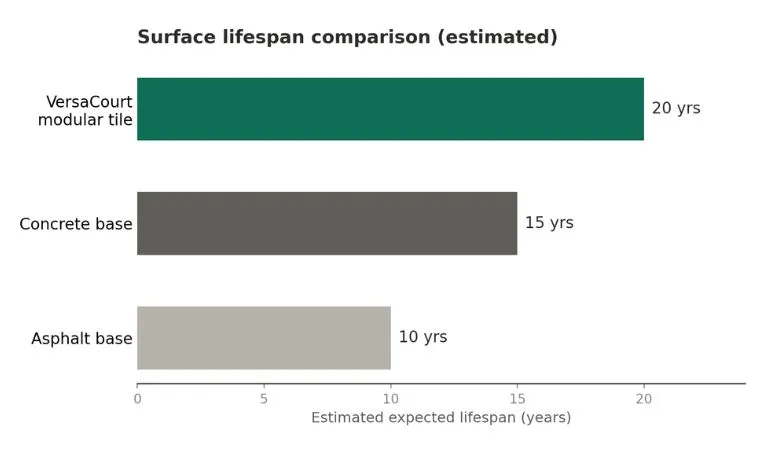
Start with the clearest example. Most outdoor courts need to be repainted every two to three years just to stay playable and look presentable. That is a recurring cost baked into the budget forever. VersaCourt’s modular tile system does not carry that requirement. Over a 10 to 15 year window, skipping that cycle alone changes the math on what the court actually costs to own.
How the Returns Actually Show Up, by Buyer Type
The “asset, not expense” argument only holds up if you can trace it to a specific buyer’s numbers. Here is how it plays out across the groups who install courts most often.
Schools & Municipalities
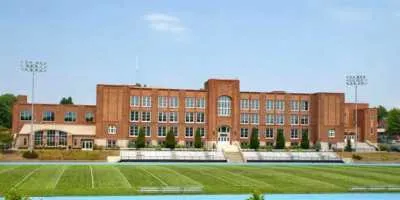
For a school district or a parks department, the real metric is not the sticker price. It is cost-per-use over the life of the surface. A court that gets used every day, by PE classes, athletics, and community programs, needs to hold up under that volume without constant intervention.
This is where surface choice matters more than most buyers realize. Asphalt and concrete courts require periodic resurfacing and patching to stay safe and playable, and those cycles add up over a 15 to 20 year ownership period. VersaCourt’s modular surface sits on top of a standard subsurface and is built to reduce how often that resurfacing and patching cycle happens, not to replace the need for a properly engineered base. The result is a lower total cost of ownership per use, even when the upfront number looks comparable.
Multi-Family & HOA
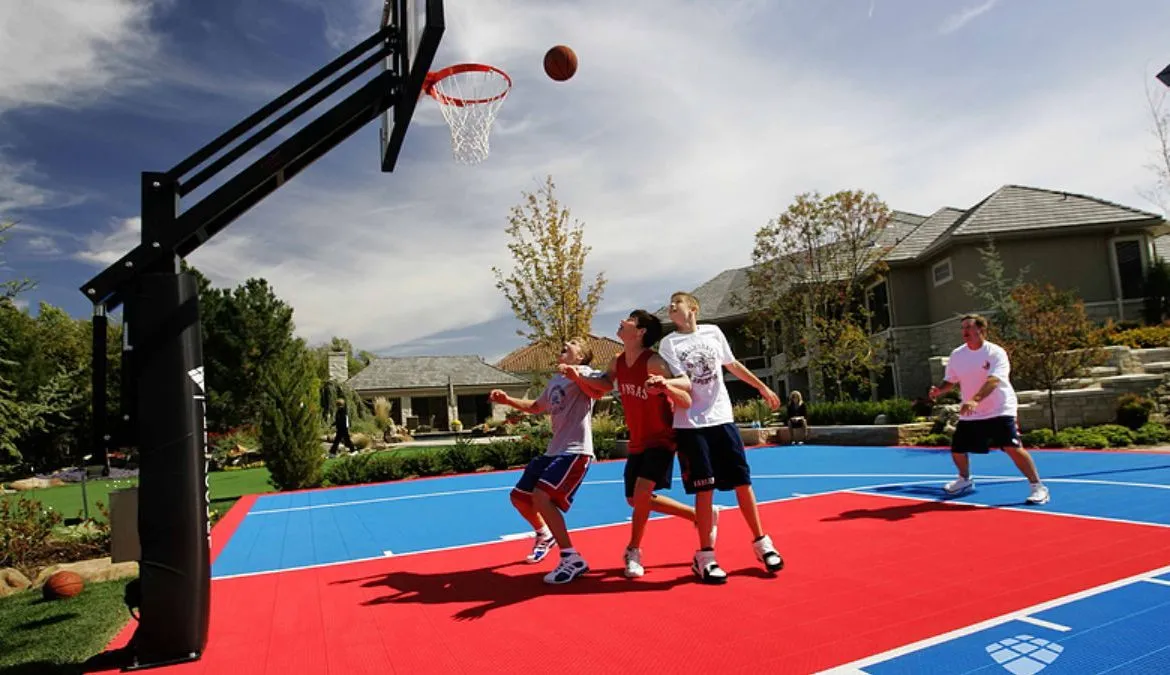
For property managers and HOA boards, a court’s return shows up in rent premiums, resale value, and resident retention. A well-maintained, always-playable court is a visible amenity that prospective tenants and buyers notice on a walkthrough.
At the individual home and community level, the effect is easier to trace. A court reads as permanent, functional space rather than decoration, and unlike a pool it carries no ongoing chemical, heating, or liability cost for a buyer to price in. That is why courts tend to lead the listing rather than sit in the amenity footnotes, with Zillow and similar platforms routinely putting the court in the headline photo and home features coverage pointing to backyard courts as the element separating a property from otherwise identical comps.
Clubs & Fitness
For clubs and fitness facilities, the court is a membership driver. A safer, more consistent playing surface supports the kind of experience that justifies premium membership tiers and keeps members renewing. Surface-related safety features, consistent traction, shock absorption, reduced injury risk, factor directly into retention and into a club’s ability to hold or raise membership pricing without pushback.
Facilities & Parks
For multi-use facilities and parks departments running paid programming, court availability is revenue. Fewer maintenance closures mean more bookable hours across the year, and a surface that performs consistently across sports supports a broader, more profitable programming calendar.
Planning Tools That De-Risk the Investment
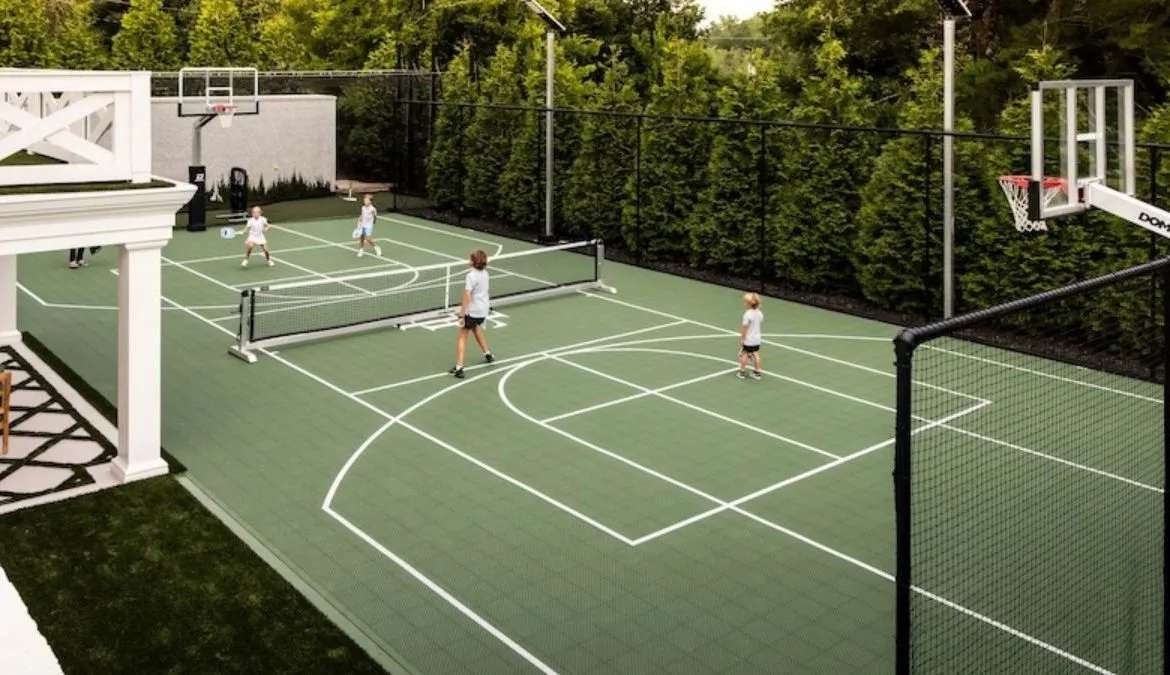
The biggest risk in a court investment is not the surface itself, it is committing to a budget before understanding what the finished project actually requires. A few tools help close that gap before a shovel goes in the ground.
- 3D Court Designer: Lets buyers visualize layout, color, and features, and generate a realistic cost estimate before committing to a final design.
- CADdetails library: Gives architects and specifiers ready-to-use specification files, useful for anyone bringing a court into a larger construction or renovation project.
- In-house consultants and dealer network: Puts a real person in the process to catch site-specific issues, drainage, subsurface condition, local code, before they become budget surprises.
The Procurement Advantage: Sourcewell
For schools and government buyers, procurement timelines can be as costly as the project itself. Sourcewell is a cooperative purchasing contract that lets public agencies buy from an already-vetted, competitively bid contract instead of running their own bidding process from scratch. Approved vendors are awarded Sourcewell Contracts and look like this. In plain terms: it saves months of procurement time and locks in pricing that has already been through competitive review. For a budget-conscious school district or municipality, that is a real financial and timeline lever, not just a compliance checkbox.
VersaCourt is an awarded Sourcewell supplier under contract #031022-REC, which means a district, municipality, parks department, college, or nonprofit can buy a court without running its own RFP. Any public entity can register with Sourcewell for free to become a participating agency, and eligibility extends beyond government to public and private K-12 schools, universities, and nonprofits such as YMCAs and Boys and Girls Clubs.
The practical effect is that pricing has already been competitively solicited and awarded, so the buyer skips straight to quoting and installation while staying compliant with competitive-bid requirements. For a summer install window that depends on breaking ground before the school year, removing the bid cycle from the front end is often the difference between the project happening this year or next.
The Bottom Line
A court is not a line item you write off the day it is installed. It is an asset that pays back through avoided maintenance cycles, property value, membership growth, and usable hours on the calendar. The buyers who get the best return are the ones who model that return before they build, not after.
Ready to see what a court investment looks like for your specific project? [Run the numbers with our cost calculator], and check our [funding database] for programs that could offset your upfront cost.
FAQ
Is an athletic court a good investment for a school or municipality? Yes, when measured on cost-per-use over the surface’s lifespan rather than upfront price alone. Surfaces that avoid frequent resurfacing and patching cycles typically show a lower total cost of ownership over 15 to 20 years.
How often does a typical outdoor court need to be repainted? Most traditional outdoor courts need repainting every two to three years to remain playable and presentable. Modular tile systems like VersaCourt are designed to reduce or eliminate this recurring cost. [PLACEHOLDER: confirm exact claim with VersaCourt]
Does a modular court surface replace the need for a subsurface? No. A modular surface sits on top of a properly engineered subsurface. It reduces how often resurfacing and patching are needed compared to asphalt or concrete, it does not eliminate the need for a correctly built base.
What is Sourcewell and how does it help with court procurement? Sourcewell is a cooperative purchasing contract that allows schools and government agencies to buy from an already competitively bid contract, avoiding a lengthy independent bidding process while still securing competitive pricing.