
Written By
Ryan Caravalho

Edited By
Antti Rydman
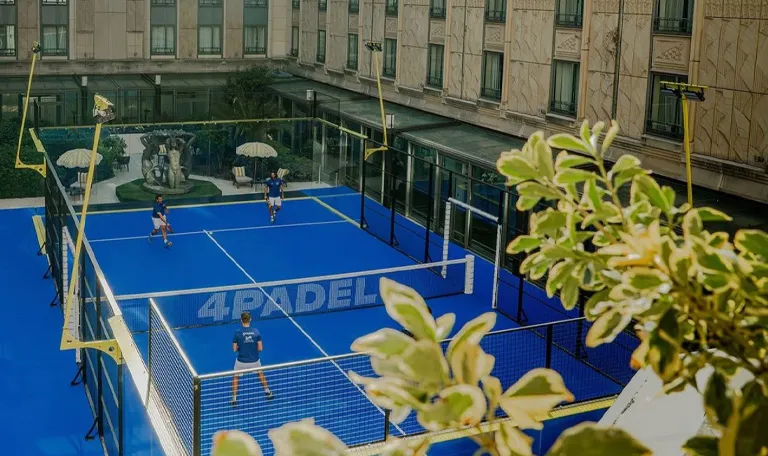
Written By
Ryan Caravalho
Edited By
Antti Rydman
Selecting a padel court is not simply a design decision. The type of court chosen will influence how the facility performs, how it is experienced by players and spectators, and how well it holds up over time in its specific environment.
Differences in structure, visibility, wind resistance, and installation flexibility can significantly impact both the short-term success and long-term viability of a project. For developers and operators, these factors shape everything from user experience to maintenance and operational consistency. For project owners, they directly affect cost, durability, and how the court fits within the broader facility.
MejorSet has built a range of court systems designed for different use cases, from high-end clubs and tournament venues to residential and recreational installations. With experience across international markets and official involvement in professional padel, the company’s lineup reflects a mix of performance-focused engineering and architectural design.
This article reviews MejorSet’s primary court types, focusing on how each model performs in real-world scenarios and where it is best suited.
What to Evaluate When Reviewing a Padel Court
Before looking at specific models, it helps to understand what actually differentiates one court from another.
Key factors include:
- Visibility and spectator experience
- Panoramic designs remove visual obstructions and improve viewing angles, which is especially important for clubs and event venues.
- Structural design and wind resistance
- Outdoor courts must be engineered for local conditions, particularly in exposed or coastal environments.
- Indoor and outdoor adaptability
- Some courts are designed to perform equally well in both settings, while others are optimized for specific environments.
- Portability and installation flexibility
- Portable or modular systems can be critical for rooftops, temporary venues, or locations with limited construction options.
- Customization and branding
- Color schemes, lighting configurations, and visual elements play a larger role in club and commercial settings.
These factors provide a framework for understanding how different MejorSet courts fit into different types of projects.
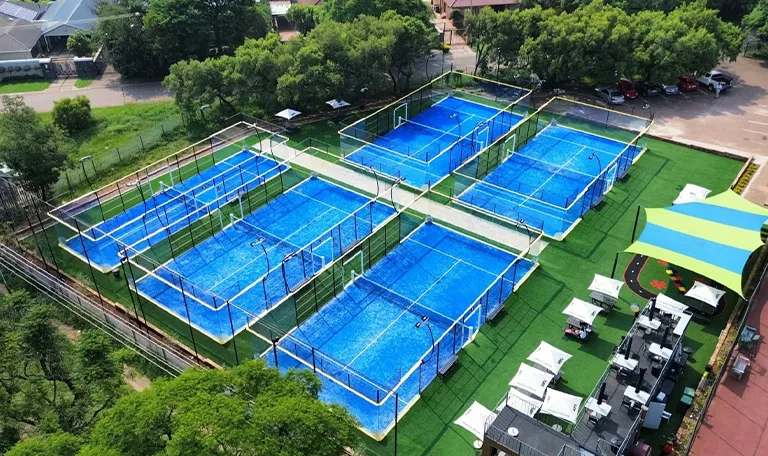
MejorSet’s Approach to Court Design
Across its lineup, MejorSet focuses heavily on panoramic and structural court systems. The goal is not just to meet standard dimensions, but to refine how the court performs visually and structurally in different environments.
Most models are designed for both indoor and outdoor use, with variations in reinforcement, framing, and wind resistance depending on the application. The company also places emphasis on customization, allowing courts to be adapted visually and functionally to fit specific venues.
This approach results in a lineup where the differences between models are not just aesthetic. They are tied to how and where the court will be used.
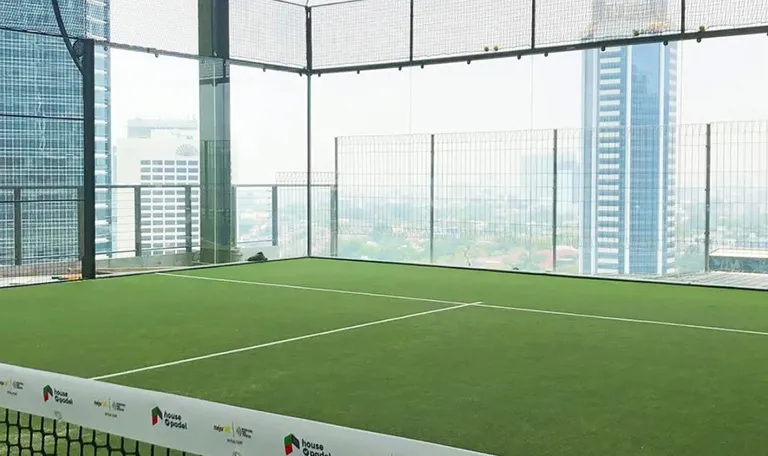
Panoramic RC10 Review
The Panoramic RC10 sits at the center of MejorSet’s lineup and is often positioned as a balanced option between structural strength and visual openness.
Its defining feature is a self-supporting steel structure combined with panoramic glass back walls, allowing for clear viewing without compromising stability. The system is reinforced with structural rings and cross members, which helps maintain rigidity in outdoor conditions.
With certified wind resistance up to 140 km/h (87 mph), the RC10 is well suited for outdoor installations, including exposed environments where durability is a concern. At the same time, its clean design and unobstructed ends make it visually appealing for clubs and spectator-focused venues.
The availability of a portable version adds flexibility, particularly for rooftop installations or locations where permanent construction is not feasible.
Best fit: premium clubs, rooftop courts, and outdoor facilities that need a reliable balance of durability and visibility.
Full Panoramic Review
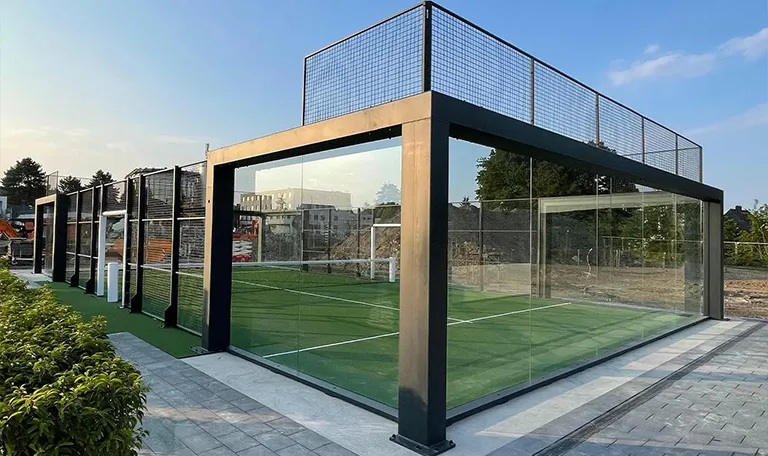
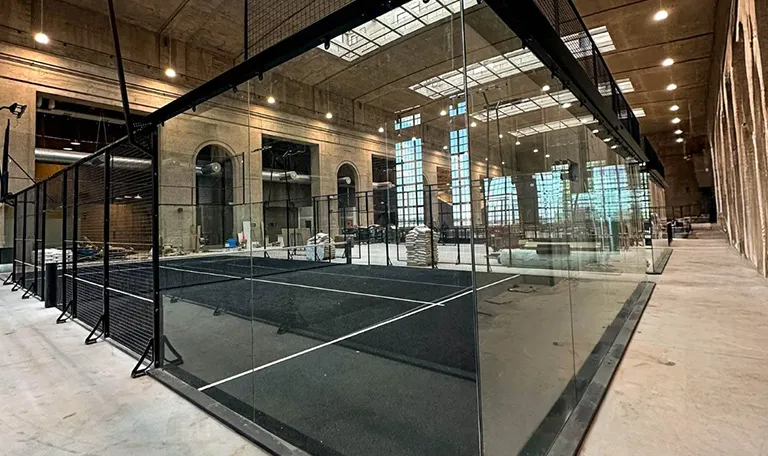
The Full Panoramic model takes the visibility concept further by eliminating metal posts at the glass corners, creating a completely open 360-degree viewing experience.
This design is especially effective in environments where spectator experience is a priority. The absence of corner posts creates a cleaner visual field, which is often preferred for showcase courts and broadcast settings.
Structurally, the system is still engineered for outdoor use, with wind resistance up to 120 km/h (75 mph) and reinforced steel components. While it offers strong durability, its focus is clearly on visual openness rather than maximum structural reinforcement.
Like the RC10, the Full Panoramic model can be installed indoors or outdoors and is available in portable configurations.
Best fit: high-end clubs, showcase venues, and projects where aesthetics and visibility are central to the experience.
RC MAX Review
The RC MAX builds on the RC10 concept but is specifically reinforced for more demanding outdoor environments.
With thicker structural elements and a design focused on increased resistance, it is intended for installations where wind load and environmental exposure are major considerations. This makes it particularly relevant in parts of the United States where weather conditions can be more extreme.
While it maintains the panoramic design and unobstructed views of the RC10, its positioning is clearly more performance-driven. The emphasis is on long-term durability and structural reliability rather than purely visual features.
Best fit: outdoor commercial installations, coastal areas, and projects where structural performance is a primary concern.
X-Treme Court Review
The X-Treme model is the most specialized option in the lineup, designed for extreme environmental conditions.
Engineered to withstand wind speeds up to 265 km/h (165 mph), it goes well beyond standard outdoor requirements. Reinforced materials, anti-corrosion treatments, and certified structural performance make it suitable for hurricane-prone regions and highly exposed sites.
This level of reinforcement makes it less of a general-purpose court and more of a solution for specific project challenges. In typical environments, it may exceed what is necessary, but in the right context, it addresses conditions that other systems cannot.
Best fit: coastal, hurricane-prone, and high-exposure environments where structural limits are a defining factor.
FIP Official Court Review
The FIP Official Court is designed in collaboration with the International Padel Federation and reflects a standardized approach to professional-level play.
Structurally based on the RC10, it incorporates official colors, refined visibility, and high-quality materials such as 12 mm tempered glass. The goal is to align with recognized standards for competition environments while maintaining the performance characteristics of a reinforced panoramic system.
For clubs and facilities looking to position themselves within the competitive padel ecosystem, this model offers a clear connection to official standards without requiring a full custom design.
Best fit: clubs and venues that want alignment with federation-level standards and a more competition-oriented presentation.
Premier Official Court Review
The Premier Official Court is designed with a more distinctive identity, tied to professional tournament environments.
Features such as custom lighting structures, branded elements, and the Shock Lock absorption system differentiate it from more standard models. The overall design is intended to create a stronger visual presence and enhance the experience of high-level events.
This is not a general-purpose court. It is built for venues that want a flagship installation or a signature element within their facility.
Best fit: tournament venues, flagship clubs, and projects where branding and visual identity are part of the value.
Kids Court Review
The Kids Court is a scaled-down version of the Full Panoramic concept, designed for younger players and family-oriented environments.
With reduced dimensions and safety-focused features such as anti-injury mesh and reinforced materials, it allows facilities to introduce padel in a more accessible format. Despite its size, it maintains the same material quality and design approach as the larger courts.
While it is a niche offering, it can be a useful addition for clubs and resorts looking to expand programming and appeal to a broader audience.
Best fit: family clubs, resorts, and facilities focused on youth development and recreational use.
Matching MejorSet Courts to Project Type
The table below provides a simplified view of how different MejorSet court models align with common project types.
| Court Model | Best Fit | Primary Strength | Key Consideration |
|---|---|---|---|
Panoramic RC10 | Premium clubs, rooftops | Balance of visibility and strength | Middle-ground option across environments |
Full Panoramic | Showcase venues | Maximum visibility | Slightly lower structural focus |
RC MAX | Outdoor commercial projects | Reinforced durability | Designed for high exposure |
X-Treme | Extreme environments | Maximum wind resistance | Highly specialized use case |
FIP Official | Competitive clubs | Federation alignment | More competition-focused |
Premier Official | Flagship venues | Visual identity and branding | Not a general-use court |
Kids Court | Family and resort settings | Accessibility for youth | Limited to specific use cases |
Choosing the Right MejorSet Court for the Project
Selecting the right court depends on how the facility will be used and where it will be installed.
Key factors include:
- Level of play and target audience
- Environmental conditions, particularly wind and exposure
- Importance of visibility and spectator experience
- Need for portability or non-permanent installation
- Branding and customization requirements
In many cases, the decision comes down to prioritizing either structural performance or visual openness, with some models offering a balance of both.
Installation and Planning Considerations in the U.S.
Padel court installation is relatively straightforward, but it requires careful planning.
Standard courts measure 20m by 10m, with additional space needed for safe play around the perimeter. A flat, level base or concrete foundation is required, along with access to power for lighting systems.
Indoor installations must meet minimum height requirements, typically around 7 meters.
Planning approval varies by location, and projects may require coordination with local zoning regulations and permitting processes. For many buyers, this is an area where working with an experienced provider can simplify the process.
Production timelines are typically around four weeks, with installation completed in two to three days per court when handled by a professional team. It is also important to note that quoted pricing generally includes the court structure and core components, while transportation, installation, and site preparation are handled separately.
Common Questions About MejorSet Padel Courts
What is the difference between panoramic and full panoramic courts?
Panoramic courts retain some structural framing, while full panoramic designs remove corner posts for a more open viewing experience.
Which court is best for windy or coastal environments?
Reinforced models such as the RC MAX or X-Treme are better suited for high-exposure conditions.
Can padel courts be installed on rooftops or temporary sites?
Yes, portable versions are available for projects where permanent installation is not possible.
What should project owners consider before building a padel court?
Site conditions, permitting requirements, intended usage, and long-term maintenance should all be evaluated early in the process.
Final Thoughts on MejorSet Padel Courts
MejorSet’s court lineup covers a wide range of applications, from recreational and family-focused installations to high-performance tournament environments.
The differences between models are tied to how each court is intended to perform, whether that means maximizing visibility, reinforcing structural durability, or supporting a specific type of venue.
For developers and facility owners, the most effective approach is to match the court type to the project’s environment and goals. When those align, the result is not just a visually appealing installation, but a court that performs consistently over time.
Meet the SVC Experts
Written by: Ryan Caravalho, Contributing Author
Ryan Caravalho has been writing for Sports Venue Calculator since 2022, specializing in clear, research-driven content for sports facility planners. With a background in tech, F&B, non-profits, and NGOs, he brings a broad, practical perspective to early-stage sports construction projects.
Read more from Ryan.
Edited by: Antti Rydman, Managing Editor
Antti Rydman is a Co-Founder and the Managing Editor of Sports Venue Calculator. A member of the founding team, Antti has led editorial operations since 2021, shaping the platform’s content strategy and overseeing its growth as a trusted resource for sports facility planning and construction.
Read more about Antti.