If you’re thinking about building a sports facility, there’s a good chance you’re underestimating what it actually takes — and that mistake can cost you hundreds of thousands of dollars.
We sat down with Thomas Shay, Principal and Senior Technical Leader at Woodard & Curran, an integrated engineering, science, and operations consulting firm operating across the U.S. With nearly 20 years of experience planning and designing municipal, institutional, and private sports facilities, Tom has seen first-time project owners make the same costly mistakes — and he knows exactly how to avoid them.
Here is what he wants every first-time sports facility planner to know before they spend a single dollar.
Tip #1: Hire a Qualified Professional Before You Do Anything Else
We started with the obvious question: I have land, I have a vision, how difficult can this really be?
Tom’s answer was immediate. “It depends,” he said — a phrase he returned to often throughout our conversation. On one end of the spectrum, he explained, a greenfield development — open land with few existing constraints — can be relatively straightforward to plan and execute. “On the opposite end of the range would be a brownfield redevelopment, which would come with some contamination, or a site that has some subsurface challenges. Those projects can be very difficult, with multiple levels of constraints.” In general, sites available for sports and recreation facilities are often available precisely because they are not well-suited for higher-value commercial or residential development.
His first piece of advice is unambiguous: hire a qualified professional before you reach out to a single vendor or supplier.
“It’ll sound biased,” Tom admits, “but based on my 20 years or so of experience — I would advise you hire a qualified professional.” That professional, he explains, acts as an owner’s representative: “We’re not completely independent — obviously, we’re hired by the owner. But in this case, we would be looking out for the owner’s best interest.” In practice, that means evaluating multiple vendors and suppliers rather than leaving the owner to rely on a single source that “may or may not provide the necessary or desirable products or services.” The goal, Tom says, is a more competitive process: “We might be able to suggest multiple that would make the project more competitive in their best interest.”
Prefer to watch the interview instead of reading it? Click play below!
Tip #2: Invest in a Feasibility Study
If there is one phase that determines whether a sports facility project succeeds or fails, Tom says it is the feasibility study — and it happens right at the beginning.
“It’s the most important piece of the project,” he told us. “It’s an area where first-time owners or project developers can try to move too far, too fast, because they want to show progress. They might not understand the value of a feasibility study. But that’s really where the probability of project success increases.”
A proper feasibility study, in Tom’s practice, typically includes a kickoff to understand the owner’s goals, scope, schedule, and budget; a site visit and review of all existing data; a conceptual layout; geotechnical investigations such as borings and test pits; an Engineer’s Opinion of Probable Construction Cost (EOPCC); a permitting review; and a realistic project schedule.
The goal, he stresses, is not just to confirm that a project is feasible. It is to figure out what the right project is. Tom’s team has advised clients to walk away from sites entirely when constraints were too severe. In one case, they recommended against developing a parcel shared between a school and a municipality because of extensive wetlands, floodplain issues, easements, and overlapping ownership rights.
In another project, his team ranked four potential sites and initially placed the one the owner ultimately chose to develop last — because it was the most complex and costly to build. But the owner chose it anyway, and Tom now considers that the right call.
“We need to consider the overall project value, not just the financial value,” he said. “There were social and environmental benefits to add into the equation — what we might label triple bottom line. They chose that site because it was better for the community.”
Tip #3: Understand Your Site - From the Ground Up
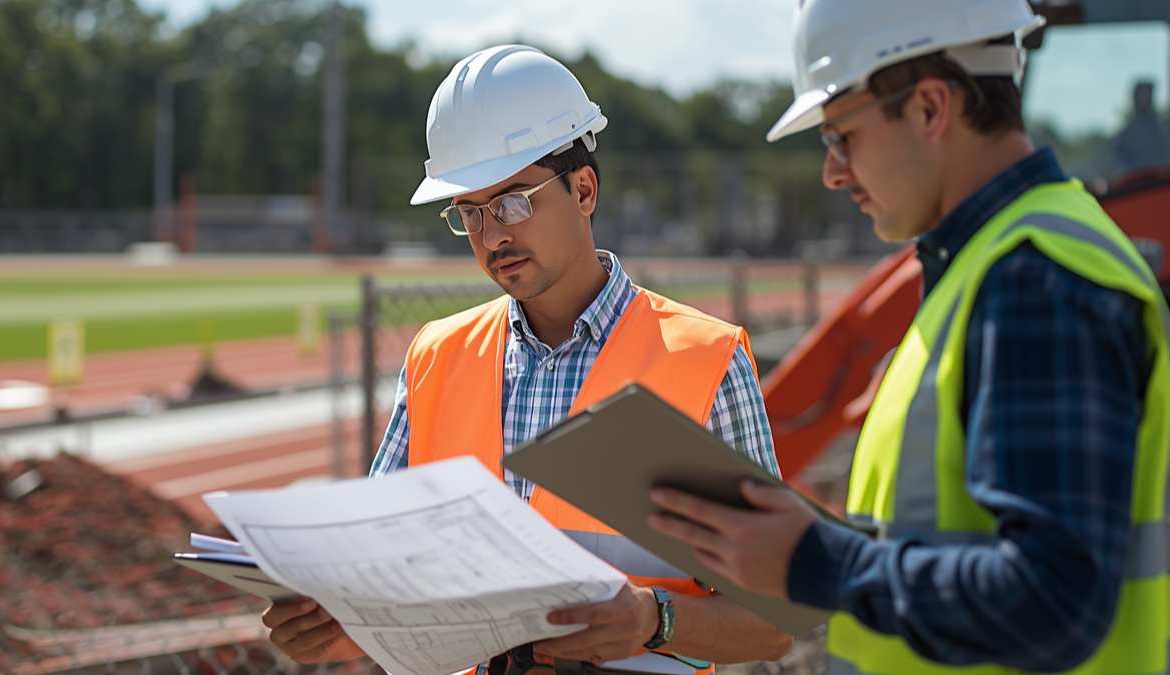
Before any design work begins, Tom’s team works from the bottom up. Understanding what is happening beneath the surface of a site, he argues, is the most risk-laden part of any sports facility project.
“Everything above the ground can be designed and planned for,” he said. “But we really need to do a good job of understanding what’s going on beneath the surface in order to mitigate those risks and increase the probability of success.”
His team begins every engagement with an extensive desktop study — reviewing utility maps, wetland and floodplain data, soil types, and historical site uses. Former industrial or commercial sites can carry contamination and soils management that significantly impacts cost and schedule. Urban and coastal sites in the eastern U.S. frequently present geotechnical challenges that are invisible until you dig.
We asked Tom what the ideal scenario looks like when a new client walks in the door.
“A dream scenario would be to have a project owner come in with a box or a thumb drive of data that shows what went on on that site historically — borings, test pits, prior uses, construction records,” he said. “The more the owner brings to us, the more time we can spend coming up with solutions instead of spending time trying to gather that information.”
In practice, he told us, it is almost always the opposite — but bringing whatever documentation you have will save time and money.
Tip #4: Build a Realistic Budget - and Include What First-Timers Always Forget
We asked Tom about the budget side of things, and whether an owner who has done some online research and gathered a few vendor quotes is in good shape.
“Absolutely on the right track,” he said, “because those costs are going to be part of the process. But just be careful what you find on the internet. With the advent of AI, you can get a lot of information, but it’s not always true or applicable to your project.”
The bigger risk, he explained, is not the research itself — it is what gets left out.
“A very simple place to make mistakes is on markups. If you get a price for a field surface, a court surface, and a track surface, and lighting and bleachers — those costs, if you have a general contractor, are going to be marked up by a significant percentage. There could easily be a million dollars in markups on those raw subtotal costs that an owner is not thinking about.”
Beyond markups, the costs that first-time owners most commonly overlook include general conditions such as temporary facilities and erosion controls; stormwater management, which Tom describes as increasingly demanding in most U.S. jurisdictions; geotechnical and environmental remediation work; utility service upgrades (sports lighting projects frequently require electrical infrastructure the site was never built to support); and cost escalation when there is a gap of two or more years between early estimates and actual construction.
On contingency, Tom is direct: carry no less than 25% at the conceptual phase, and maintain 5–10% even during construction.
“A lot of times unexpected changes during construction come from unforeseen conditions in the subsurface,” he said. “That’s where you want to have something in reserve.”

Tip #5: Plan Your Timeline Backwards from Your Target Opening Date
We put a common scenario to Tom: a contractor has told a first-time owner that building a football field will take three to six months. Is that realistic?
“Yes, but cautiously,” he said. “The contractor’s input on construction schedule is critical — they’ll know their capabilities and their current workload. But the rest of the project schedule is not in that three to six months. The planning, the permitting, and the design development are not included in that number.”
Those phases, depending on complexity, can add 12 months or more to the total project duration — and that assumes no significant complications from local regulations or politics.
“The local politics is very important,” Tom noted. “Different communities have different goals and standards. City councils and local boards have a lot of power, and those approvals take time.”
His advice: start with your target opening date and work backwards. A school that needs a football field ready for the fall season, for example, needs to begin planning no later than the previous spring or summer. In northern states, winter conditions further compress the window for site investigations.
“We need to think about when we have to have permits submitted, which means when we need to have design development progress to make those submittals — and then work back to when the planning phase needs to start.”
The Bottom Line
We closed by asking Tom for the single most important piece of advice he would give a first-time project owner starting the process today.
“It would be super biased, but for all the right reasons,” he said. “Hire a qualified professional to help you during the planning phase and complete a feasibility study for your project. Do the research online to understand what you need and how much you think it might cost — gather the information you have. And then engage with an experienced professional. You’ll have a smooth process, and you’ll be able to come up with the right project and do it the right way.”
Thomas Shay is a Principal and Senior Technical Leader at Woodard & Curran, specializing in sports, parks, and recreation facility design for municipal, institutional, and private clients across the United States.