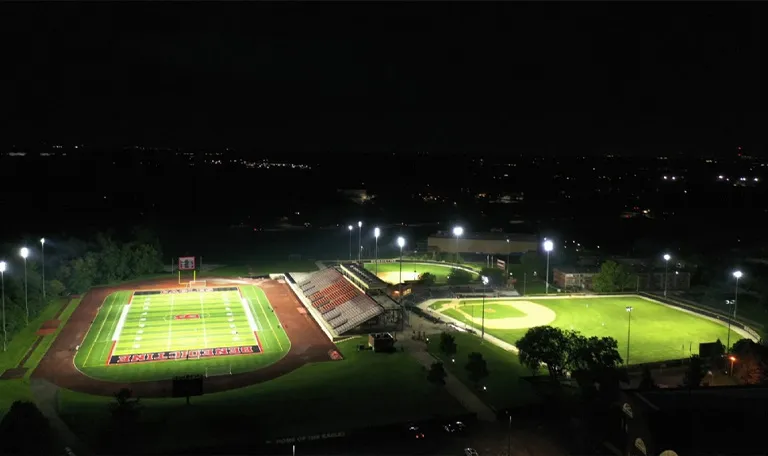
Artificial turf and field construction tend to get most of the attention in sports facility projects.
But sports lighting ultimately determines how often the field can be used, how well it performs, and whether it meets the expectations of athletes, officials, and spectators.
From installation through long-term operation, sports lighting plays a central role in both performance and usability. It influences gameplay, scheduling flexibility, safety, and even the overall perception of a facility.
To better understand what separates a well-executed lighting system from one that creates ongoing challenges, we spoke with Lucy Lee, Founder and CEO of Duvon Lighting, a U.S.-based manufacturer of sports, area, and solar lighting systems.
With a focus on engineered, project-specific lighting solutions, Duvon Lighting works with contractors, municipalities, and facility owners to design systems that perform consistently in real-world conditions.
Why Sports Lighting Plays a Critical Role in Facility Performance, with Duvon Lighting Insights
Lighting does more than illuminate a field. It defines how that field functions.
“Lighting is what makes the field usable, not just visible. If the lighting is inconsistent, too dim, or poorly controlled, it affects how athletes track the ball, how officials make calls, and whether the facility can meet league requirements.”
Lucy Lee, Duvon™ Lighting
Performance on the field is directly tied to visibility. Uneven lighting or poor control can affect reaction time, depth perception, and overall gameplay. For officials, it can affect decision-making accuracy. For spectators, it changes how the game is experienced.
Lighting also affects how a facility operates. As Lucy explains, extended hours play a direct role in how much value a facility can deliver.
“From an ownership standpoint, lighting also determines how many hours the facility can operate and whether it can host games, tournaments, or televised events. A well-lit field extends usage. A poorly lit one limits it, regardless of how much was invested in the rest of the project.”

Where Sports Lighting Projects Often Go Wrong, According to Duvon Lighting
Most lighting issues do not come from a single bad decision. They come from incomplete evaluation during planning.
“What we see most often is not a bad decision—it’s just incomplete evaluation. Many projects rely on brand reputation or a clean-looking photometric, but don’t fully look at what drives the result."
Photometric reports are often treated as the final word, but they are only as reliable as the inputs behind them.
“A photometric report is only as accurate as its assumptions. Items like LLF, uniformity, glare control, and spill at the property line need to be realistic, not just compliant on paper. Two designs can show similar numbers but perform very differently once installed.”
Another common issue is focusing too narrowly on individual components instead of the system as a whole. Long-term performance depends on how the full system is designed and engineered to work together, rather than on individual components alone.
Why Duvon Lighting Recommends Early Planning for Sports Lighting
Lighting is often treated as a later-stage decision, but by that point, many of the most important variables have already been locked in.
“Lighting should be addressed during site layout, at the same time as grading, field orientation, and utilities. Pole height, setbacks, foundation loads, and aiming angles all need to be coordinated early.”
When lighting is introduced late in the process, it is forced to adapt to decisions that were not made with it in mind. That typically leads to more fixtures, higher costs, and compromises in performance.
Early coordination allows the lighting system to be designed as part of the overall project, rather than added onto it.
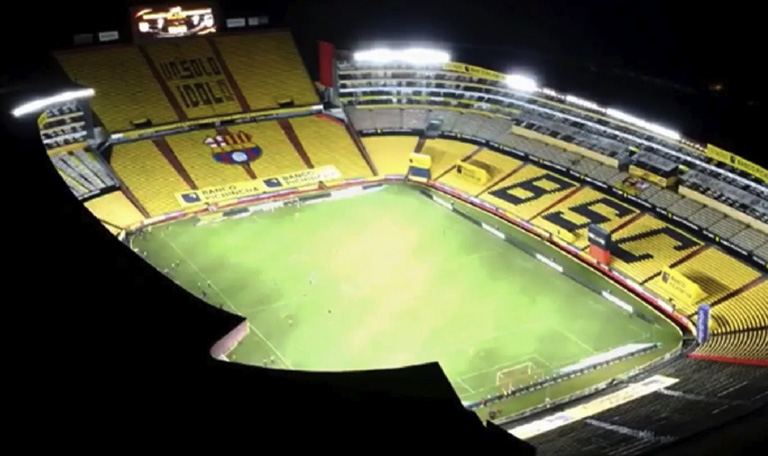
How Poor Sports Lighting Impacts Players and Facilities
The truth is, most lighting issues are not always obvious until the field is in use.
“The most immediate issue is glare and uneven light. If players are looking into high-intensity sources or moving between bright and dark areas, it affects reaction time and depth perception.”
In sports where the ball travels vertically, those inconsistencies can create real safety concerns. As Lucy notes, “in sports where the ball travels vertically—tennis, baseball, soccer—that becomes a real safety concern.”
The impact extends beyond players. Spectators notice uneven lighting as well. It can make the game harder to follow and give the entire facility a lower-quality feel, even if other elements of the project were done well.
Key Sports Lighting Metrics Duvon Lighting Uses to Guide Design
Strong lighting design is built on measurable criteria, not assumptions. Every project “should be built around measurable criteria, not assumptions.”
There are several core metrics that should be clearly defined in any lighting proposal:
- IES RP-6 guidelines for sports lighting
- Horizontal and vertical foot-candle levels
- Uniformity ratios
- Glare control
- Light levels at the property line
As Lucy explains, “if a proposal doesn’t clearly define these, it’s not complete, and there is no objective way to evaluate whether the system will perform.”
For contractors and planners, these metrics provide a framework for comparing systems and understanding how a design will translate into real-world performance.

The Hidden Costs of Sports Lighting Systems
The initial price is often the most visible number in a project. It is not always the most important one. “Upfront price is only part of the picture. The real cost shows up after installation,” says Lee.
Common issues that increase long-term cost include:
- Adding fixtures later to correct dark areas
- Higher energy consumption
- Increased maintenance from lower-quality components
- Retrofits due to light spill complaints
As Lucy puts it, “a lower bid that requires correction later is not a lower-cost project.”
Looking beyond upfront pricing and evaluating total system performance can prevent these issues from surfacing later.
How Duvon Lighting Sees LED and Controls Changing Sports Lighting
LED technology has shifted how lighting systems are designed and operated.
“LED has allowed much tighter control of light distribution. Instead of simply flooding a field, lighting can now be placed more precisely where it’s needed while reducing spill outside the site.”
This level of control improves both performance on the field and compliance with surrounding conditions.
Controls have also evolved, giving facilities more flexibility in how lighting is used. As Lucy explains, “controls have also improved how facilities operate, allowing adjustment for practice, games, or events and enabling remote management.”
This flexibility allows facilities to adapt lighting levels based on use, improving efficiency without sacrificing performance.
Glare and Light Spill Challenges in Sports Lighting, According to Duvon Lighting
Lighting design does not stop at the field boundary.
“Because that’s where projects get challenged. If light extends beyond the property or creates visible glare, it leads to complaints, delays, and sometimes redesign requirements.”
Many municipalities now enforce strict limits on light levels at the property line, especially for facilities near residential areas.
A good lighting system needs to fully illuminate the field while remaining controlled outside of it. As Lucy explains, “that balance has to be engineered from the start.”

How Duvon Lighting Uses Photometric Design to Prevent Costly Mistakes
Photometric design is one of the most important tools in planning a lighting system.
“A photometric plan shows exactly what the field will look like before anything is installed.”
It allows teams to evaluate light levels, uniformity, and spill based on real conditions, including pole placement and aiming angles.
It also helps optimize fixture count and system efficiency. As Lucy notes, “it also helps optimize fixture count so you’re not overbuilding or underperforming.”
Without this step, decisions are based on assumptions rather than validated outcomes, which is where most problems begin.
How Duvon Lighting Designs for Schools, Municipalities, and Sports Complexes
Not all facilities have the same requirements, and lighting design needs to reflect that. As Lucy puts it, “the differences matter,” especially when comparing schools, municipalities, and competitive facilities.
Schools often need flexible systems that can support multiple sports and usage patterns. Municipal projects typically have tighter restrictions around light spill and community impact. Competitive facilities require higher light levels and stricter uniformity.
“Each type of project requires a different design approach,” Lucy explains, “and treating them the same typically leads to compromises.”
Duvon Lighting on Solar Sports Lighting: When It Works and When It Doesn’t
Solar lighting is becoming more common, but it is not a one-size-fits-all solution. As Lucy explains, “solar is a strong option where grid power is limited, costly, or impractical,” particularly for parks, pathways, and recreational facilities.
For higher-level sports lighting applications, solar requires more detailed planning.
“For higher-level sports lighting, solar requires careful system sizing, including battery capacity and operating hours.”
The key is aligning the system with how the facility will actually be used, rather than assuming a standard approach will work across all applications.
How Duvon Lighting Recommends Starting a Sports Lighting Project
Successful projects start with clear expectations. As Lucy explains, “define performance expectations early and require a detailed photometric plan before making decisions.”
That early clarity shapes every downstream decision. It also highlights the importance of working with a provider who can support the design process throughout, rather than simply supplying equipment.
“Most issues in lighting projects can be avoided with proper planning upfront,” she says, “and that is where the real value is created.”

The Future of Sports Lighting, According to Duvon Lighting
The expectations around sports lighting continue to increase.
“The industry is moving toward tighter control and higher expectations.”
This includes stricter regulations on light spill, broader use of smart controls, and greater integration with energy systems such as solar and storage.
As Lucy explains, “the shift is toward complete, engineered systems that are designed, validated, and supported—not just supplied.”
Final Thoughts on Sports Lighting
Sports lighting plays a central role in how facilities perform, operate, and deliver value over time. From early planning through long-term use, the difference between a system that works and one that creates ongoing challenges often comes down to design, engineering, and execution.
As expectations continue to rise, the focus is shifting toward systems that are not only installed but fully engineered to meet performance goals from day one through the life of the facility.