
Written By
Ryan Caravalho

Edited By
Antti Rydman
Home » LED Sports Lighting » LED Softball Field Lighting Cost and Design Guide (2026)
Written By
Ryan Caravalho
Edited By
Antti Rydman
LED Lighting Installation Cost for a Softball Field (2026)
Installing a new LED lighting system for a softball field in 2026 typically costs between $135,000 and $350,000, according to real-world U.S. project data from our internal database.
This cost range includes:
Site preparation (excavation, trenching, and underground cabling)
Installation labor for poles, mounting, and wiring
System design and calibration, including lighting layout, aiming, and performance verification
The lighting cost of a softball field varies based on field size, competition level, and lighting classification standards. Higher-level fields that require brighter, more uniform lighting—such as for televised games or tournament play—typically sit at the upper end of the range.
There are federal, state, and local grants and incentive programs available to help offset the cost of LED softball lighting systems. These can significantly reduce your upfront investment—especially for schools and municipalities.
If you already have all the specs for your softball field and you just want a cost estimate for the lighting system, try our LED softball field lighting cost calculator.
| Softball field lighting new installation cost | Cost range |
|---|---|
Softball LED Sports Lighting System, Poles, Control system | $94,500 – $245,000 |
Installation of poles | $20,250 – $52,500 |
Installation of fixtures | $10,125 – $26,250 |
Wiring from contactors to poles | $6,750 – $17,500 |
Structural engineering | $3,375 – $9,000 |
Total | $135,000 – $350,000 |
Project Timeline
An LED softball field lighting project typically takes between 3 to 6 months. This includes time for planning, permitting, equipment procurement, installation, and final testing. Timelines can vary based on local approval processes, supplier lead times, and site-specific conditions.
LED Retrofit Cost for a Softball Field Lighting System (2026)
Retrofitting a softball field lighting system to LED in 2025 typically costs between $55,000 and $165,000, based on verified retrofit projects in our U.S. database.
Unlike new installations, LED retrofits usually require less site prep and infrastructure work. In many cases:
Existing light poles can be reused
Foundations and conduit lines may remain intact
Electrical systems can be tapped into without full rewiring
The biggest decision is whether to retrofit just the lamps, or to upgrade entire fixtures and supporting infrastructure. This choice significantly affects both the cost and the long-term lighting performance.
To get a more precise estimate using your project specs, try our LED retrofitting cost calculator for softball lighting systems.
What Affects Retrofit Cost?
- Competition level and illumination standards
Age and condition of current system
Type of LED retrofit (lamp swap vs. full fixture upgrade)
Quality of fixtures and controls
Read more about what influences LED sports lighting costs in our separate guide.
Kick Off Your LED Sports Lighting Project
We’ve created a set of tools designed to assist facility managers and project planners in initiating their projects and help connect them with the professionals in the industry.
Operating and Maintenance Costs
Once the installation is done and the lights are on, you can sigh in relief and pat yourself on the back. From there onwards, all you will have to calculate is the amount of money you save over the next 100,000 hours of enjoying a well-lit softball field! LED outdoor sports lighting systems require very little maintenance thanks to the long lifespan and durable engineering of the units. You can forget about all the hassle with changing light bulbs and the related labor costs.
How Softball Field Lighting Installation Costs Vary Regionally
The cost to install softball field lighting systems varies across the United States due to factors like field dimensions, level of play (youth, high school, or competitive), required illumination levels, pole configuration, regional labor costs, electrical infrastructure needs, permitting requirements, and local market demand. The ranges below are based on actual softball lighting project data from our internal database, combined with city and state-level construction cost index data to account for regional pricing differences. This approach provides a more accurate, location-adjusted estimate to support effective budget planning.
Explore estimated softball field lighting costs by city and state, based on the key factors that influence total project cost. Click on any state to access detailed guides, localized pricing insights, and planning recommendations.
Top Insights
- Most expensive cities: San Francisco, New York City, Boston, San Jose, San Diego
- Most affordable cities: Jacksonville, Columbus, San Antonio, Indianapolis, Oklahoma City
- Highest-cost states: Hawaii, Alaska, California, New York, Massachusetts
- Lowest-cost states: Mississippi, Arkansas, Alabama, West Virginia, Kentucky
- Typical U.S. range: $135,000 – $350,000
Use our softball field lighting cost calculator to receive a tailored estimate for your softball field project in just two minutes, based on your specific requirements.
Softball Field Lighting Installation Cost per City
| City | URL | State | Cost Range | Cost Factors | Cost Insights |
|---|---|---|---|---|---|
| Atlanta | https://directory.sportsvenuecalculator.com/led-sports-lighting/georgia/atlanta | GA | $145,800 - $378,000 | Labor: Mid | Materials: Mid | Equipment: Mid | Above-average diamond lighting costs; suburban rec complexes offer better value. |
| Austin | https://directory.sportsvenuecalculator.com/led-sports-lighting/texas/austin | TX | $155,250 - $402,500 | Labor: High | Materials: High | Equipment: Mid | Growing softball leagues keep field lighting costs elevated metro-wide. |
| Boston | https://directory.sportsvenuecalculator.com/led-sports-lighting/massachusetts/boston | MA | $190,350 - $493,500 | Labor: High | Materials: High | Equipment: High | Union labor and permitting place Boston among costlier Northeast markets. |
| Charlotte | https://directory.sportsvenuecalculator.com/led-sports-lighting/north-carolina/charlotte | NC | $143,100 - $371,000 | Labor: Mid | Materials: Mid | Equipment: Mid | Moderate diamond lighting costs; surrounding counties offer slightly lower rates. |
| Chicago | https://directory.sportsvenuecalculator.com/led-sports-lighting/illinois/chicago | IL | $164,700 - $427,000 | Labor: High | Materials: High | Equipment: High | City permitting and union labor drive diamond lighting costs high; suburbs more affordable. |
| Columbus | https://directory.sportsvenuecalculator.com/led-sports-lighting/ohio/columbus | OH | $132,300 - $343,000 | Labor: Mid | Materials: Mid | Equipment: Mid | Stable contractor pricing; a reliable mid-range market for softball lighting. |
Dallas / Fort Worth | https://directory.sportsvenuecalculator.com/led-sports-lighting/texas/dallas | TX | $151,200 - $392,000 | Labor: High | Materials: High | Equipment: Mid | High softball demand keeps installation costs elevated; outlying cities offer better rates. |
| Denver | https://directory.sportsvenuecalculator.com/led-sports-lighting/colorado/denver | CO | $159,300 - $413,000 | Labor: Mid | Materials: High | Equipment: High | Above-average diamond lighting costs; mountain facilities face a steep premium. |
| Des Moines | https://directory.sportsvenuecalculator.com/led-sports-lighting/iowa/des-moines | IA | $128,250 - $332,500 | Labor: Low | Materials: Mid | Equipment: Low | Low overhead and easy permitting; cost-efficient for softball lighting. |
| Houston | https://directory.sportsvenuecalculator.com/led-sports-lighting/texas/houston | TX | $140,400 - $364,000 | Labor: Mid | Materials: Mid | Equipment: Mid | Reasonable costs; coastal humidity requires corrosion-resistant fixtures. |
| Indianapolis | https://directory.sportsvenuecalculator.com/led-sports-lighting/indiana/indianapolis | IN | $128,250 - $332,500 | Labor: Low | Materials: Mid | Equipment: Low | Low labor rates and competitive contractors; cost-efficient for softball lighting. |
| Jacksonville | https://directory.sportsvenuecalculator.com/led-sports-lighting/florida/jacksonville | FL | $135,000 - $350,000 | Labor: Low | Materials: Mid | Equipment: Low | Mid-range diamond lighting costs; rural North Florida projects run below average. |
| Los Angeles | https://directory.sportsvenuecalculator.com/led-sports-lighting/california/los-angeles | CA | $180,900 - $469,000 | Labor: High | Materials: High | Equipment: High | Energy codes and union labor push costs high; Inland Empire offers savings. |
| Miami | https://directory.sportsvenuecalculator.com/led-sports-lighting/florida/miami | FL | $162,000 - $420,000 | Labor: High | Materials: High | Equipment: High | Wind-load requirements push diamond lighting pole costs above average. |
| Minneapolis | https://directory.sportsvenuecalculator.com/led-sports-lighting/minnesota/minneapolis | MN | $152,550 - $395,500 | Labor: Mid | Materials: Mid | Equipment: High | Frozen ground shortens seasons; seasonal scheduling essential for softball lighting. |
| New York City | https://directory.sportsvenuecalculator.com/led-sports-lighting/new-york | NY | $205,200 - $532,000 | Labor: High | Materials: High | Equipment: High | Most expensive U.S. market for diamond lighting; NJ and CT offer alternatives. |
| Oklahoma City | https://directory.sportsvenuecalculator.com/led-sports-lighting/oklahoma/okc | OK | $118,800 - $308,000 | Labor: Low | Materials: Low | Equipment: Low | Low electrical labor and competitive contractors; strong value for softball lighting. |
| Orlando | https://directory.sportsvenuecalculator.com/led-sports-lighting/florida/orlando | FL | $141,750 - $367,500 | Labor: Mid | Materials: Mid | Equipment: Mid | Mid-range costs for most projects; sports tourism facilities trend higher. |
| Philadelphia | https://directory.sportsvenuecalculator.com/led-sports-lighting/pennsylvania/philadelphia | PA | $164,700 - $427,000 | Labor: High | Materials: High | Equipment: Mid | Prevailing wage elevates diamond lighting costs; South Jersey and Delaware offer lower rates. |
| Phoenix | https://directory.sportsvenuecalculator.com/led-sports-lighting/arizona/phoenix | AZ | $147,150 - $381,500 | Labor: Mid | Materials: Mid | Equipment: Mid | Year-round conditions keep diamond lighting competitive; Scottsdale trends higher. |
| San Antonio | https://directory.sportsvenuecalculator.com/led-sports-lighting/texas/san-antonio | TX | $129,600 - $336,000 | Labor: Low | Materials: Mid | Equipment: Low | Low overhead and simple permitting; most affordable Texas city for softball lighting. |
| San Diego | https://directory.sportsvenuecalculator.com/led-sports-lighting/california/san-diego | CA | $183,600 - $476,000 | Labor: High | Materials: High | Equipment: Mid | Coastal permitting and structural requirements keep costs elevated; East County lower. |
| San Francisco | https://directory.sportsvenuecalculator.com/led-sports-lighting/california/san-francisco | CA | $213,300 - $553,000 | Labor: High | Materials: High | Equipment: High | Among the highest in the U.S. for diamond lighting; permitting and labor drive costs. |
| San Jose | https://directory.sportsvenuecalculator.com/led-sports-lighting/california/san-jose | CA | $186,300 - $483,000 | Labor: High | Materials: High | Equipment: High | Scarce contractors and high wages; one of California's costliest for softball lighting. |
| Seattle | https://directory.sportsvenuecalculator.com/led-sports-lighting/washington/seattle | WA | $144,450 - $374,500 | Labor: High | Materials: High | Equipment: High | Wet-weather requirements and high labor add cost to softball field lighting. |
| Tampa | https://directory.sportsvenuecalculator.com/led-sports-lighting/florida/tampa | FL | $179,550 - $465,500 | Labor: Mid | Materials: Mid | Equipment: Mid | Consistent contractors and mid-range labor; reliable for softball lighting projects. |
| Washington DC | https://directory.sportsvenuecalculator.com/led-sports-lighting/washington-dc | $179,550 - $465,500 | Labor: High | Materials: High | Equipment: High | Prevailing wage and complex permitting; softball lighting among the costliest in the Mid-Atlantic. |
Softball Field Lighting Installation Cost per State
| State | URL | Cost range | Cost Factors | Cost Insights |
|---|---|---|---|---|
| Alabama | https://directory.sportsvenuecalculator.com/led-sports-lighting/alabama | $118,800 - $308,000 | Labor: Low | Materials: Low | Equipment: Low | Smaller diamond footprint keeps softball lighting costs below baseball statewide. |
| Alaska | https://directory.sportsvenuecalculator.com/led-sports-lighting/alaska | $175,500 - $455,000 | Labor: High | Materials: High | Equipment: High | Fewer poles than baseball; remote logistics still add steep material premiums. |
| Arizona | https://directory.sportsvenuecalculator.com/led-sports-lighting/arizona | $132,300 - $343,000 | Labor: Mid | Materials: Mid | Equipment: Mid | Smaller diamond footprint; Phoenix moderate; Tucson and rural AZ most affordable. |
| Arkansas | https://directory.sportsvenuecalculator.com/led-sports-lighting/arkansas | $117,450 - $304,500 | Labor: Low | Materials: Low | Equipment: Low | Small diamond footprint keeps costs competitive; one of most affordable states. |
| California | https://directory.sportsvenuecalculator.com/led-sports-lighting/california | $162,000 - $420,000 | Labor: High | Materials: High | Equipment: High | Smaller footprint helps; prevailing wage still elevates labor costs in metro CA. |
| Colorado | https://directory.sportsvenuecalculator.com/led-sports-lighting/colorado | $141,750 - $367,500 | Labor: Mid | Materials: Mid | Equipment: Mid | Smaller footprint helps; mountain resort towns still carry significant premiums. |
| Connecticut | https://directory.sportsvenuecalculator.com/led-sports-lighting/connecticut | $151,200 - $392,000 | Labor: High | Materials: Mid | Equipment: Mid | Fewer poles than baseball; union labor still keeps CT above national average. |
| Delaware | https://directory.sportsvenuecalculator.com/led-sports-lighting/delaware | $137,700 - $357,000 | Labor: Mid | Materials: Mid | Equipment: Mid | Small state; smaller footprint keeps costs competitive; northern DE slightly higher. |
| Florida | https://directory.sportsvenuecalculator.com/led-sports-lighting/florida | $135,000 - $350,000 | Labor: Mid | Materials: Mid | Equipment: Mid | Fewer poles than baseball; coastal wind-load still adds cost in South FL. |
| Georgia | https://directory.sportsvenuecalculator.com/led-sports-lighting/georgia | $129,600 - $336,000 | Labor: Low | Materials: Mid | Equipment: Mid | Smaller footprint; Atlanta metro moderately higher than rural GA. |
| Hawaii | https://directory.sportsvenuecalculator.com/led-sports-lighting/hawaii | $182,250 - $472,500 | Labor: High | Materials: High | Equipment: High | Fewer poles helps; island freight still adds steep premiums. |
| Idaho | https://directory.sportsvenuecalculator.com/led-sports-lighting/idaho | $128,250 - $332,500 | Labor: Low | Materials: Mid | Equipment: Mid | Smaller footprint competitive statewide; Boise slightly above rural ID. |
| Illinois | https://directory.sportsvenuecalculator.com/led-sports-lighting/illinois | $140,400 - $364,000 | Labor: High | Materials: Mid | Equipment: Mid | Fewer poles than baseball; Chicago union labor still very elevated. |
| Indiana | https://directory.sportsvenuecalculator.com/led-sports-lighting/indiana | $126,900 - $329,000 | Labor: Low | Materials: Mid | Equipment: Mid | Small diamond footprint; Indianapolis among most affordable major Midwest metros. |
| Iowa | https://directory.sportsvenuecalculator.com/led-sports-lighting/iowa | $125,550 - $325,500 | Labor: Low | Materials: Mid | Equipment: Mid | Small footprint plus low labor; among most affordable Midwest states. |
| Kansas | https://directory.sportsvenuecalculator.com/led-sports-lighting/kansas | $124,200 - $322,000 | Labor: Low | Materials: Mid | Equipment: Mid | Small footprint plus affordable labor; among most affordable states. |
| Kentucky | https://directory.sportsvenuecalculator.com/led-sports-lighting/kentucky | $121,500 - $315,000 | Labor: Low | Materials: Mid | Equipment: Low | Small footprint; Louisville and Lexington slightly above rural KY. |
| Louisiana | https://directory.sportsvenuecalculator.com/led-sports-lighting/louisiana | $124,200 - $322,000 | Labor: Low | Materials: Mid | Equipment: Mid | Gulf humidity corrosion requirements add cost; New Orleans highest statewide. |
| Maine | https://directory.sportsvenuecalculator.com/led-sports-lighting/maine | $132,300 - $343,000 | Labor: Low | Materials: Mid | Equipment: Mid | Small footprint plus frozen ground scheduling; rural ME most affordable. |
| Maryland | https://directory.sportsvenuecalculator.com/led-sports-lighting/maryland | $145,800 - $378,000 | Labor: High | Materials: Mid | Equipment: Mid | DC suburb prevailing wage adds cost; Baltimore moderate; rural MD lowest. |
| Massachusetts | https://directory.sportsvenuecalculator.com/led-sports-lighting/massachusetts | $155,250 - $402,500 | Labor: High | Materials: Mid | Equipment: Mid | Fewer poles; union labor still keeps MA above national average statewide. |
| Michigan | https://directory.sportsvenuecalculator.com/led-sports-lighting/michigan | $132,300 - $343,000 | Labor: Mid | Materials: Mid | Equipment: Mid | Smaller footprint; Detroit moderately above rural MI; frozen ground statewide. |
| Minnesota | https://directory.sportsvenuecalculator.com/led-sports-lighting/minnesota | $137,700 - $357,000 | Labor: Mid | Materials: Mid | Equipment: Mid | Frozen ground compresses scheduling; Twin Cities above rural MN. |
| Mississippi | https://directory.sportsvenuecalculator.com/led-sports-lighting/mississippi | $116,100 - $301,000 | Labor: Low | Materials: Low | Equipment: Low | Small footprint plus low labor; among most affordable states nationally. |
| Missouri | https://directory.sportsvenuecalculator.com/led-sports-lighting/missouri | $126,900 - $329,000 | Labor: Low | Materials: Mid | Equipment: Mid | Small footprint; KC and St. Louis slightly above rural MO. |
| Montana | https://directory.sportsvenuecalculator.com/led-sports-lighting/montana | $129,600 - $336,000 | Labor: Low | Materials: Mid | Equipment: Mid | Small footprint; remote rural MT adds logistics; Billings most affordable. |
| Nebraska | https://directory.sportsvenuecalculator.com/led-sports-lighting/nebraska | $122,850 - $318,500 | Labor: Low | Materials: Mid | Equipment: Low | Small footprint plus low labor; among most affordable states. |
| Nevada | https://directory.sportsvenuecalculator.com/led-sports-lighting/nevada | $137,700 - $357,000 | Labor: Mid | Materials: Mid | Equipment: Mid | Smaller footprint; Las Vegas resort market still elevates contractor rates. |
| New Hampshire | https://directory.sportsvenuecalculator.com/led-sports-lighting/new-hampshire | $141,750 - $367,500 | Labor: Mid | Materials: Mid | Equipment: Mid | Small footprint moderate; southern NH Boston corridor slightly higher. |
| New Jersey | https://directory.sportsvenuecalculator.com/led-sports-lighting/new-jersey | $155,250 - $402,500 | Labor: High | Materials: Mid | Equipment: Mid | Fewer poles; prevailing wage still keeps NJ above national average. |
| New Mexico | https://directory.sportsvenuecalculator.com/led-sports-lighting/new-mexico | $126,900 - $329,000 | Labor: Low | Materials: Mid | Equipment: Mid | Smaller footprint moderate; Santa Fe resort market above Albuquerque. |
| New York | https://directory.sportsvenuecalculator.com/led-sports-lighting/new-york | $159,300 - $413,000 | Labor: High | Materials: High | Equipment: Mid | NYC union labor elevates even smaller footprint; upstate significantly lower. |
| North Carolina | https://directory.sportsvenuecalculator.com/led-sports-lighting/north-carolina | $128,250 - $332,500 | Labor: Low | Materials: Mid | Equipment: Mid | Small footprint; Charlotte and Raleigh moderately above rural NC. |
| North Dakota | https://directory.sportsvenuecalculator.com/led-sports-lighting/north-dakota | $135,000 - $350,000 | Labor: Mid | Materials: Mid | Equipment: Mid | Small footprint; frozen ground scheduling statewide; Fargo slightly above rural. |
| Ohio | https://directory.sportsvenuecalculator.com/led-sports-lighting/ohio | $128,250 - $332,500 | Labor: Mid | Materials: Mid | Equipment: Mid | Small footprint; Columbus and Cleveland slightly above Cincinnati and rural OH. |
| Oklahoma | https://directory.sportsvenuecalculator.com/led-sports-lighting/oklahoma | $122,850 - $318,500 | Labor: Low | Materials: Mid | Equipment: Low | Small footprint plus low labor; among most affordable states nationally. |
| Oregon | https://directory.sportsvenuecalculator.com/led-sports-lighting/oregon | $137,700 - $357,000 | Labor: Mid | Materials: Mid | Equipment: Mid | Smaller footprint; Portland wet-weather specs still add statewide cost. |
| Pennsylvania | https://directory.sportsvenuecalculator.com/led-sports-lighting/pennsylvania | $148,500 - $385,000 | Labor: Mid | Materials: Mid | Equipment: Mid | Smaller footprint; Philly prevailing wage still elevated; Pittsburgh moderate. |
| Rhode Island | https://directory.sportsvenuecalculator.com/led-sports-lighting/rhode-island | $126,900 - $329,000 | Labor: High | Materials: Mid | Equipment: Mid | Smaller footprint; union labor still among pricier small Northeast markets. |
| South Carolina | https://directory.sportsvenuecalculator.com/led-sports-lighting/south-carolina | $124,200 - $322,000 | Labor: Low | Materials: Mid | Equipment: Mid | Smaller footprint; coastal wind-load hardware adds cost near Charleston. |
| South Dakota | https://directory.sportsvenuecalculator.com/led-sports-lighting/south-dakota | $126,900 - $329,000 | Labor: Low | Materials: Mid | Equipment: Low | Small footprint; frozen ground scheduling; Sioux Falls slightly above rural. |
| Tennessee | https://directory.sportsvenuecalculator.com/led-sports-lighting/tennessee | $130,950 - $339,500 | Labor: Low | Materials: Mid | Equipment: Mid | Small footprint; Nashville above Memphis and rural TN. |
| Texas | https://directory.sportsvenuecalculator.com/led-sports-lighting/texas | $130,950 - $339,500 | Labor: Mid | Materials: Mid | Equipment: Mid | Smaller footprint; Dallas/Houston elevated; San Antonio most affordable. |
| Utah | https://directory.sportsvenuecalculator.com/led-sports-lighting/utah | $135,000 - $350,000 | Labor: Mid | Materials: Mid | Equipment: Mid | Smaller footprint; Salt Lake City moderately above rural UT. |
| Vermont | https://directory.sportsvenuecalculator.com/led-sports-lighting/vermont | $137,700 - $357,000 | Labor: Mid | Materials: Mid | Equipment: Mid | Small footprint; frozen ground scheduling; statewide most affordable. |
| Virginia | https://directory.sportsvenuecalculator.com/led-sports-lighting/virginia | $139,050 - $360,500 | Labor: Mid | Materials: Mid | Equipment: Mid | Smaller footprint; Northern VA prevailing wage still elevated; Richmond moderate. |
| Washington | https://directory.sportsvenuecalculator.com/led-sports-lighting/washington | $148,500 - $385,000 | Labor: High | Materials: Mid | Equipment: Mid | Smaller footprint; Seattle prevailing wage and wet-weather; Spokane moderate. |
| West Virginia | https://directory.sportsvenuecalculator.com/led-sports-lighting/west-virginia | $120,150 - $311,500 | Labor: Low | Materials: Low | Equipment: Low | Small footprint plus low labor; among most affordable states. |
| Wisconsin | https://directory.sportsvenuecalculator.com/led-sports-lighting/wisconsin | $133,650 - $346,500 | Labor: Mid | Materials: Mid | Equipment: Mid | Smaller footprint; Milwaukee above Madison; frozen ground statewide. |
| Wyoming | https://directory.sportsvenuecalculator.com/led-sports-lighting/wyoming | $128,250 - $332,500 | Labor: Low | Materials: Mid | Equipment: Mid | Small footprint; remote rural WY adds logistics; Cheyenne most affordable. |

Softball Field Lighting Design
Designing lighting for a softball field involves more than just picking fixtures—it requires precision. Even with a well-thought-out plan, poor lighting performance after installation can lead to uneven coverage, visibility issues, and expensive fixes. That’s why starting with a photometric study is critical.
Lighting designers use CAD-based software to simulate how the lighting system will perform. By factoring in field dimensions, pole heights, fixture types, beam angles, and lumen output, they can ensure your setup meets IES standards for softball fields—before any equipment is installed.
A typical photometric report includes:
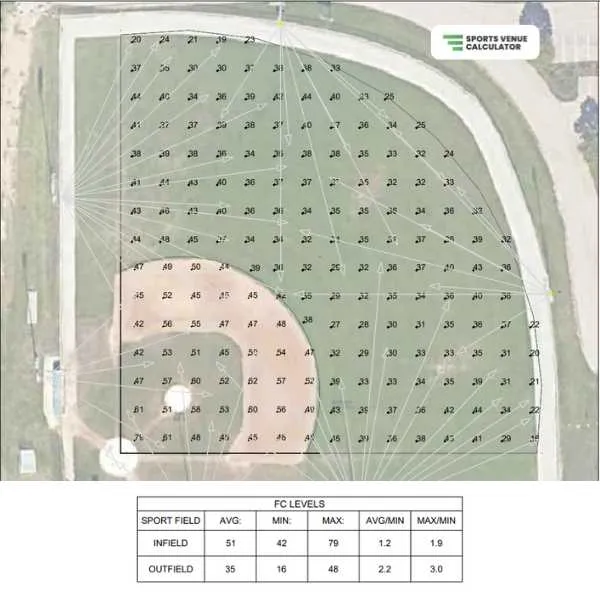
A 2D footcandle (fc) grid showing light levels across the field
3D renderings to visualize pole placement and light distribution
Light level summary (minimum, maximum, and average)
Uniformity ratios for balanced coverage
False-color heatmaps for quick visual assessment
Complete fixture and mounting specs
Before moving forward with installation, request a photometric study from a trusted U.S. sports lighting provider. It’s the best way to avoid surprises and ensure your softball field is game-ready from day one.
Softball Field Lighting: Sample Photometric Study
Below is an example of a photometric study for a high school-level (Class III) softball field, designed according to IES guidelines. While not permit-ready, it offers a realistic preview of how the system performs under real-world conditions.
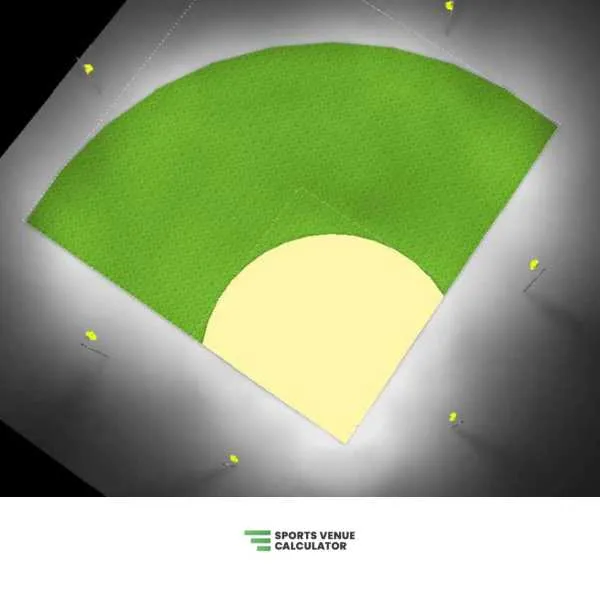
3D Lighting Layout Visualization
The 3D renderings show where each pole and fixture is placed, how high the lights are mounted, and how illumination spreads across the playing surface. This makes it easy to evaluate light angles, coverage zones, and overall performance before installation begins.

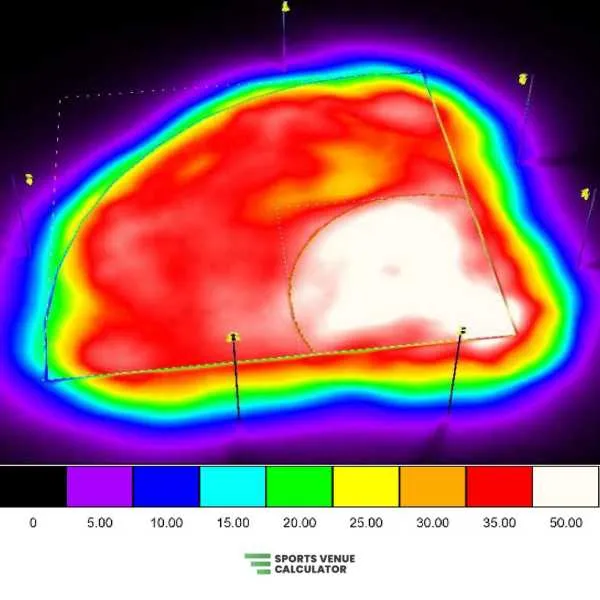
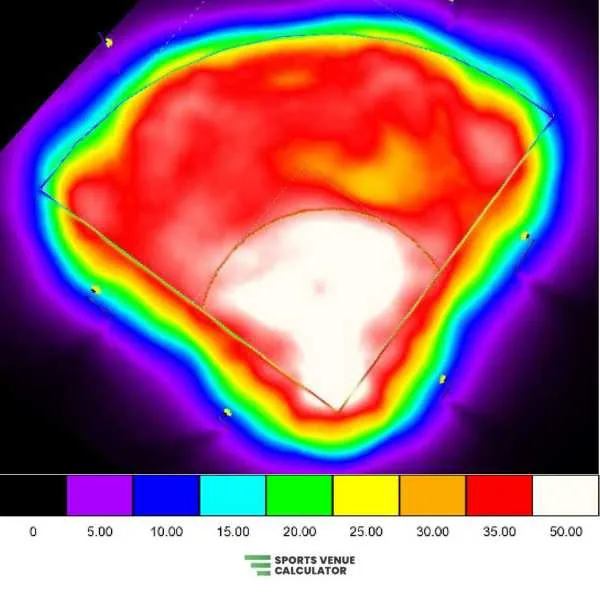
False Color Rendering (Lighting Heatmap)
This false color rendering, or lighting heatmap, visually represents how light is distributed across the softball field. Brighter areas appear in warm colors like red and yellow, while cooler tones like blue and green show dimmer zones. It’s an easy way to assess whether lighting is evenly spread and meets visibility standards across both the infield and outfield.
Designing the Ideal Lighting Setup
Photometric studies also play a key role in choosing the right lighting system. Engineers use these simulations to determine the most effective combination of fixture wattage, lumen output, beam angles, mounting height, and quantity—ensuring the field is properly illuminated for safe and competitive play.
In the example below, the layout is optimized for a high school softball field:
30 x 600W LED fixtures mounted at 70 feet with a 15° beam angle for focused infield coverage
30 x 600W LED fixtures mounted at 67 feet with a 30° beam angle for broader outfield illumination
This setup balances brightness and uniformity, reducing glare while maximizing visibility where it matters most.

Softball Field Lighting Fixture Layout
To the untrained eye, softball and baseball may look like two very similar sports. One has overhand pitching and one does it underhand, but otherwise same number of players, same equipment, same diamond-shaped field.
And from the perspective of lighting system design, it’s the diamond that makes the difference. The size of the diamond and the distances between the key points on the field influence the design and cost of the softball field lighting system.
The size of a softball field varies depending on the competition level and the age of the players, but the standard dimensions follow the specifications of a little league baseball field. The distance between bases is 60 feet and the pitcher stands 43 feet from home plate, with the outfield fence around 200 feet from home plate.
The main reasons softball fields are smaller than baseball fields are the size and weight of the ball. The ball used in softball is bigger, softer, and heavier, which means the ball travels a shorter distance and has less velocity compared to a baseball.
Position of the softball field light fixtures
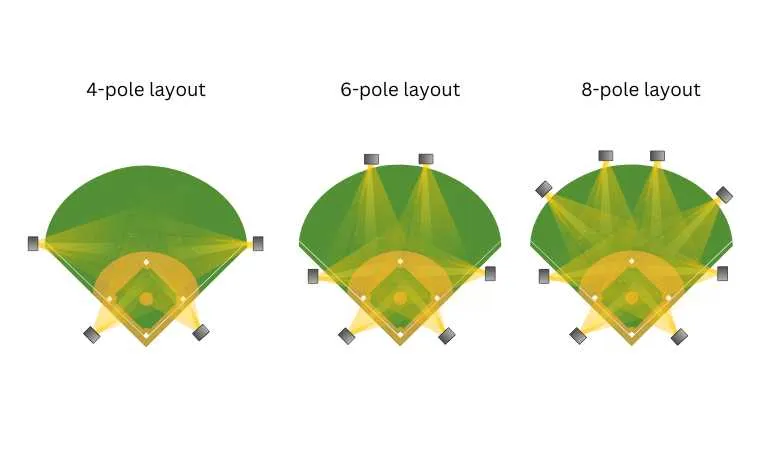
Softball diamonds are typically lit with four or six floodlights, with the deciding factor being the dimensions of the field. If you are planning to install lighting for a small softball field (distance to outfield fence up to 250 feet), then a 4-pole floodlight layout will most likely work. If the outfield fence is up to 300 feet from home, six floodlight poles become a better option.
4-pole layout
Most of the action – and certainly the quickest action – takes place in the infield, so softball fields should place floodlights on either side of home plate. These lights need to have the right combination of placement and orientation to ensure uniform lighting on the infield.
The third and fourth light poles, then, go by the left and right foul poles. They, too, need to be situated correctly, towards centerfield, so the light beams cross at the right point and the outfielders have sufficient lighting even when they have to run just outside the foul line.
Professional sports field lighting installers will take care of the necessary calculations to plan things correctly.
6-pole layout
If your softball field needs two more lighting poles, they line up roughly with 1st base and 3rd base. Because the larger diamond adds the extra space in the outfield, two lights face away from home plate. Additionally, in this setup, the floodlights that would otherwise be located by the foul poles are moved in towards the left-center field and right-center field.
Examples of LED softball field light fixtures
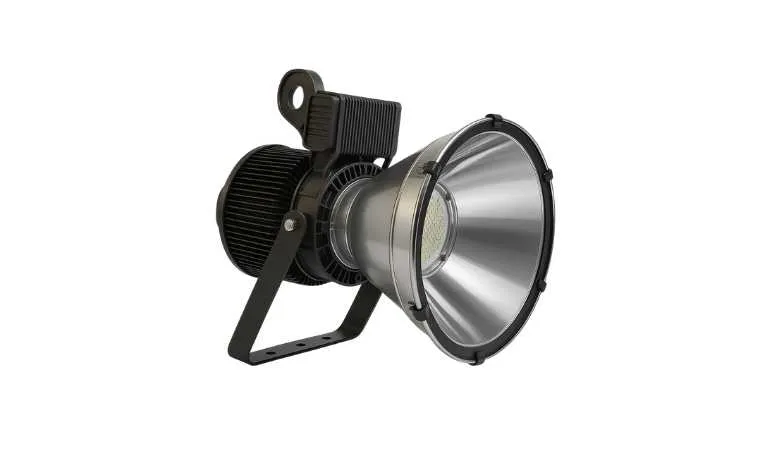
LED Floodlight Fixture for Softball Fields
- Mounting height: 35 – 70 feet
- Wattage: 300W – 1000W
- Beam angle: 15 – 60 degrees
- Best for: Outfield poles, targeted long-throw lighting behind fences
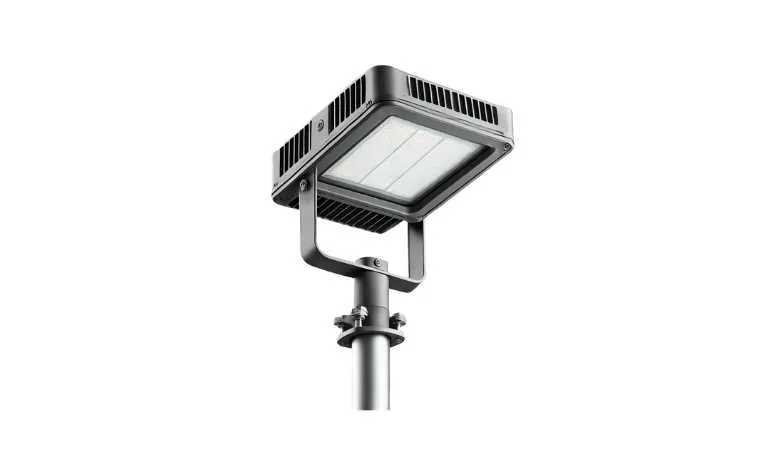
LED Shoebox Fixture for Softball
- Mounting height: 25 – 35 feet
- Wattage: 200W – 500W
- Beam angle: Type III, IV
- Best for: Practice fields, dugout areas, warm-up or batting cages
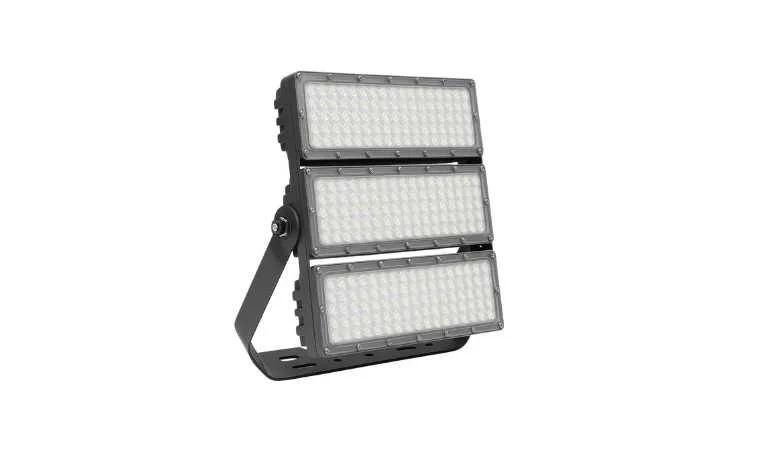
LED Modular Floodlight for Softball
- Mounting height: 40 – 80 feet
- Wattage: 400W – 1200W
- Beam angle: 15 – 60 degrees
- Best for: Competitive or multi-field complexes, outfield coverage
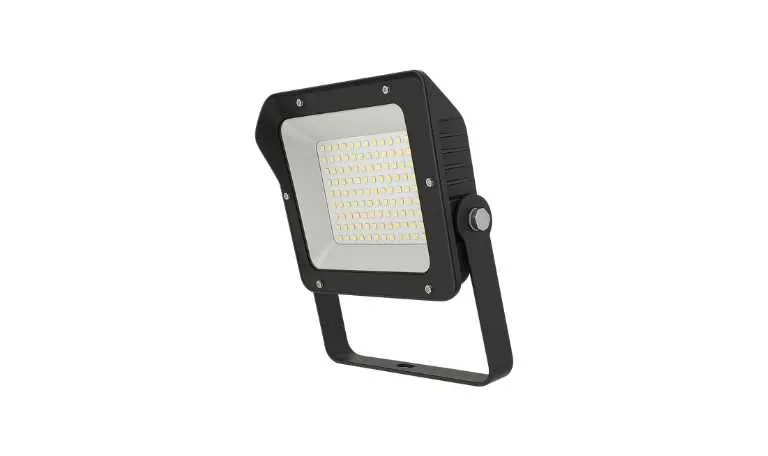
LED Asymmetric Floodlight for Softball
- Mounting height: 30 – 55 feet
- Wattage: 300W – 800W
- Beam angle: Type III, IV
- Best for: Perimeter pole layouts, especially near bleachers or dugouts
LED Sports Lighting Buyer's Guide
Our comprehensive buyer's guide covers all the essential aspects including budgeting, design, funding, and installation considerations, simplifying your decision-making process.
Get the Free Guide
How tall are softball field lights?
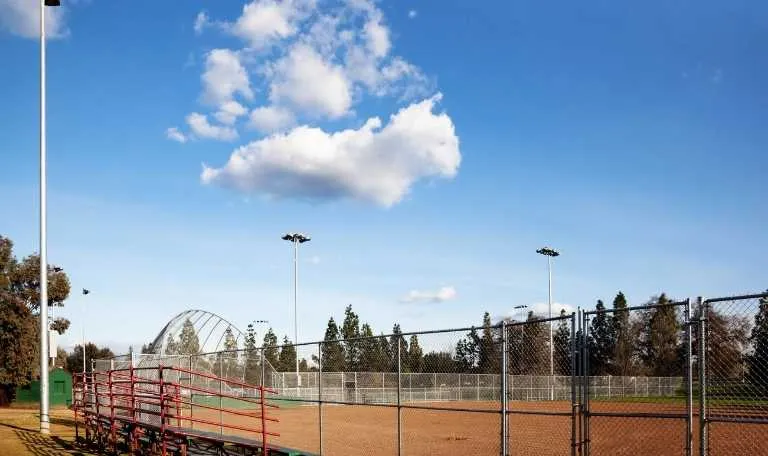
There are no set rules for how high the light poles need to be. Typically, a small softball field uses 40-50 feet tall light poles. On a larger field, you might want to go for a range of 50-60 feet.
The most important thing is to install the LED lights high enough so the players on the field will not get blinded by the lights: especially when the pitches are coming in at 70+ miles per hour!
The correct height of the lighting fixtures also enables a more pleasant experience for the spectators and prevents light from spilling outside of the ballpark. Light spillage is especially important if your softball field is located close to residential buildings.
Why You Should Go for LED Sports Lights
Softball ballparks traditionally have used metal halide or halogen floodlights to light up the playing field. Today, more and more diamonds and other sports facilities are using LED sports lighting systems.
LEDs quickly overcome the higher upfront cost of installation through huge savings in operating costs and reduced maintenance over a lifespan of up to 11 years. LED lights do not flicker, have less glare, and can be controlled easily with a mobile app. You can adjust the brightness with a flick of a button or dim some of the floodlights when they are not needed, thus reducing running costs even more.
In the LED wattage conversion table below you can see how much less power LED lights need to reach the same lumen output as a halide lamp. Fewer watts going into your lights means fewer dollars going to the electrical utility.
In the next chapter, we explain what the right lighting level for your ballpark is.
LED lighting conversion table
| Metal Halide wattage | HPS wattage | LED wattage | Average lumen output |
|---|---|---|---|
1500W | 1000W | 400W-600W | 110.000-140.000 |
2000W | 1500W | 500W-1000W | 240.000-270.000 |
4000W-7000W | 3000W | 2000W | 400.000-520.000 |
Softball Field Lighting Standards
The lighting level of a softball field depends mostly on the competition level and the size of the ballpark. In the below table is the recommended luminance for different levels of play.
Lux and lumen are closely related and can be easily confused. Lux is equal to the amount of light measured at a given spot. For us, that means how much light reaches the surface of a playing field. Lumen, on the other hand, tells you how much light is emitted from the LED lights in the first place. 1 lux equals 1 lumen per square meter. This is good to know when calculating the total amount of lumens you need to produce to light your softball diamond properly.
How many lumens do I need to light up my ballpark?
The area of a softball field is between 4,000 and 10,000 square meters, depending on the level of competition. If we use the median value, 7,000 square meters, then a professional softball field needs a total of 7,000,000 lumens to cover the whole playing surface. A high school field of the same size would need only 2,100,000 – 3,500,000 lumens.
How many LED lights do I need for my softball field?
The brightness of LED floodlights used at stadiums starts at 60,000 lumens, with the average brightness being around 150,000 lumens. This means your high school softball field would need 14-24 lighting fixtures to illuminate the whole playing field according to recommended lighting standards. Use our sports field lighting cost calculator to get an estimate of the total cost.
Softball Field Lighting: classification of play
| Sports Facility | Class I | Class II | Class III | Class IV |
|---|---|---|---|---|
Illuminance | 100 fc. / 1,000 lux. | 50 fc. / 500 lux. | 30 fc. / 300 lux. | 20 fc. / 200 lux. |
Professional Sports | x | |||
College Sports | x | x | ||
Semi-Professional | x | x | ||
Sports Clubs | x | x | x | |
Amateur Leagues | x | x | x | |
High School | x | x | x | |
Training Facilities | x | x | ||
Elementary School | x |
Kick Off Your LED Sports Lighting Project
We’ve created a set of tools designed to assist facility managers and project planners in initiating their projects and help connect them with the professionals in the industry.
Softball Lighting Companies
There are hundreds of professional lighting companies that can help you with your softball lighting project. The difficult part is to know which ones to talk to. Prices can vary for many reasons, and it’s hard to know who the real experts are and who has the customer’s best interests in mind.
Pro tip: If you are currently looking for a reliable and knowledgeable sports lighting vendor, try our sports lighting partner finder and get connected with suitable lighting partners.
Sports Venue Calculator works with the top companies in the US sports lighting industry and, as an independent advisor, we are happy to connect you with our partners. Answer a few simple questions about your project and get our list of recommended partners based on your answers. From there, our partners will take over and provide you with more detailed information about the specs of the project.
LED Softball Field Lighting Q&A
How many light fixtures are needed to light a softball field?
Most standard softball fields require 6 to 8 LED light fixtures per pole, with 4 to 6 poles total—so typically between 24 and 48 fixtures. The exact number depends on the level of play (recreational vs. competitive), field size, and desired lighting uniformity. Higher-level play or broadcast-quality lighting may require more fixtures with tighter aiming and higher output.
How many lumens are required to light a softball field?
A well-lit softball field typically needs between 200,000 and 400,000 total lumens, depending on use.
Recreational fields: around 30–50 foot-candles, translating to lower lumen requirements.
Competitive fields or those with spectators: closer to 70–100 foot-candles, which means higher lumen output and more advanced lighting layouts.
How much do lights for a softball field cost?
The cost of LED lighting for a softball field generally ranges from $135,000 to $350,000. This includes fixtures, poles, wiring, and installation. The final price depends on field size, lighting quality, soil conditions, and whether new electrical infrastructure is needed. LED systems tend to have higher upfront costs but offer long-term savings through energy efficiency and reduced maintenance.
How tall are softball field lights?
Light poles for softball fields are typically 40 to 70 feet tall.
Youth or recreational fields may use 40–50 ft poles,
High school and college-level fields usually require 60–70 ft poles to provide better light distribution and reduce glare and shadows.
Meet the SVC Experts
Written by: Ryan Caravalho, Contributing Author
Ryan Caravalho has been writing for Sports Venue Calculator since 2022, specializing in clear, research-driven content for sports facility planners. With a background in tech, F&B, non-profits, and NGOs, he brings a broad, practical perspective to early-stage sports construction projects.
Read more from Ryan.
Edited by: Antti Rydman, Managing Editor
Antti Rydman is a Co-Founder and the Managing Editor of Sports Venue Calculator. A member of the founding team, Antti has led editorial operations since 2021, shaping the platform’s content strategy and overseeing its growth as a trusted resource for sports facility planning and construction.
Read more about Antti.