






Edited By
Antti Rydman

Verified By
Karianne Jaeger
Home » Tennis Court » How Much Does It Cost to Build a Tennis Court for a School or Sports Club in 2026?
Edited By
Antti Rydman
Verified By
Karianne Jaeger
Total cost to build a tennis court (2026)
The cost to build a tennis court depends on several factors, with geographic location and the choice of surface material being among the most important. Additional work, such as removing and disposing of an existing surface, can also increase the total project cost.
The planning, construction and maintenance of outdoor tennis courts pose logistical and financial challenges for many clubs and municipalities. Anyone wishing to build a tennis court should gather information ahead of time from contractors, vendors and other sports facilities in your area to estimate the costs associated with tennis court construction. The experience of a neighboring club or a conversation with an experienced tennis court construction company can help here.
Tennis court operators should determine their requirements before deciding on a floor surface. Will it be used outdoors or indoors? Will it be covered in the winter? How sustainable should the tennis court be in order to keep renovation costs low over the long term?
The tennis court cost calculator can be used to reliably and accurately determine the budgets for the various types of surfaces.
Prefer watching over reading?
Here’s our full video breakdown of tennis court construction costs — including installation, resurfacing, maintenance, ROI, top suppliers, and funding options.
What Influences Tennis Court Construction Cost?
The cost of tennis court installation varies depending on the surface of the tennis court and the corresponding floor. For example, there are different hard court variants, artificial turf, or sand to choose from. Facility operators should know what specifications the court must meet, and how much time and money is available for maintenance over the projected life of the court.
For example, if you decide on a clay court, the installation of an automatic sprinkler system should be included in the planning. Clay courts require constant irrigation, so the cost of construction, maintenance, and the water itself should be accounted for at an early stage.
Floor surfaces for tennis courts vary in price just as they do in material and color. The extent to which the current floor can be repurposed, the number of previous layers that need to be removed, the quality of the subfloor construction, and the selection of filler (e.g. rubber granulate) are all among the factors that go into an accurate price calculation. Logistically, project managers have to determine whether the center or the adjacent courts be shut down during the renovation work, or will the construction crew have to allot for the passage and presence of players.
Get a customized cost estimate for your court project by using our tennis court cost calculator.
Tennis Court Construction Cost Ranges by Region
Tennis court construction costs vary widely across the United States, driven by regional differences in labor rates, site conditions, climate, and local construction practices. A project in one state can look very similar on paper to another — but the final cost can differ substantially once location-specific factors come into play.
The cost ranges below are based on real tennis court projects from our internal dataset, combined with industry-standard construction cost indexes at the state level. By blending real project data with broader market benchmarks, these estimates reflect how pricing behaves in actual local markets — not just generalized averages.
Explore estimated tennis court construction costs by city or state, based on the factors that most influence pricing. Click on any state to access detailed guides tailored to that location.
Get a more accurate estimate for your project using our tennis court cost calculator — it takes just a couple of minutes and is based on real project data.
Artificial Turf Field Installation Cost per City
| City | State | Cost Range |
|---|---|---|
| Atlanta | GA | $38,272 – $119,600 |
| Austin | TX | $39,771 – $124,284 |
| Boston | MA | $46,498 – $145,306 |
| Charlotte | NC | $38,195 – $119,360 |
| Chicago | IL | $48,029 – $150,090 |
| Columbus | OH | $43,716 – $136,612 |
| Dallas / Fort Worth | TX | $39,565 – $123,640 |
| Denver | CO | $40,768 – $127,400 |
| Des Moines | IA | $40,550 – $126,720 |
| Houston | TX | $39,535 – $123,548 |
| Indianapolis | IN | $40,678 – $127,120 |
| Jacksonville | FL | $37,875 – $118,360 |
| Los Angeles | CA | $44,408 – $138,774 |
| Miami | FL | $38,093 – $119,040 |
| Minneapolis | MN | $46,130 – $144,156 |
| New York City | NY | $45,997 – $143,742 |
| Oklahoma City | OK | $37,990 – $118,720 |
| Orlando | FL | $37,709 – $117,840 |
| Philadelphia | PA | $42,921 – $134,128 |
| Phoenix | AZ | $39,885 – $124,640 |
| San Antonio | TX | $39,212 – $122,536 |
| San Diego | CA | $43,907 – $137,210 |
| San Francisco | CA | $47,057 – $147,054 |
| San Jose | CA | $47,028 – $146,962 |
| Seattle | WA | $46,645 – $145,766 |
| Tampa | FL | $37,850 – $118,280 |
| Washington DC | DC | $42,347 – $132,334 |
Artificial Turf Field Installation Cost per State
| State | Cost Range |
|---|---|
| Alabama | $37,478 – $117,120 |
| Alaska | $45,894 – $143,420 |
| Arizona | $39,667 – $123,960 |
| Arkansas | $37,056 – $115,800 |
| California | $44,923 – $140,384 |
| Colorado | $40,358 – $126,120 |
| Connecticut | $44,908 – $140,338 |
| Delaware | $41,876 – $130,862 |
| District of Columbia | $44,540 – $139,188 |
| Florida | $37,811 – $118,160 |
| Georgia | $37,901 – $118,440 |
| Hawaii | $47,587 – $148,710 |
| Idaho | $39,270 – $122,720 |
| Illinois | $47,116 – $147,238 |
| Indiana | $40,499 – $126,560 |
| Iowa | $39,987 – $124,960 |
| Kansas | $39,014 – $121,920 |
| Kentucky | $38,630 – $120,720 |
| Louisiana | $37,939 – $118,560 |
| Maine | $42,111 – $131,598 |
| Maryland | $42,008 – $131,276 |
| Massachusetts | $46,351 – $144,846 |
| Michigan | $42,332 – $132,288 |
| Minnesota | $45,144 – $141,074 |
| Mississippi | $37,261 – $116,440 |
| Missouri | $42,465 – $132,702 |
| Montana | $42,273 – $132,104 |
| Nebraska | $40,507 – $126,584 |
| Nevada | $42,465 – $132,702 |
| New Hampshire | $40,115 – $125,360 |
| New Jersey | $45,364 – $141,764 |
| New Mexico | $39,535 – $123,548 |
| New York | $44,614 – $139,418 |
| North Carolina | $37,824 – $118,200 |
| North Dakota | $40,358 – $126,120 |
| Ohio | $42,568 – $133,024 |
| Oklahoma | $37,658 – $117,680 |
| Oregon | $43,554 – $136,106 |
| Pennsylvania | $42,156 – $131,736 |
| Rhode Island | $42,788 – $133,714 |
| South Carolina | $37,850 – $118,280 |
| South Dakota | $37,978 – $118,680 |
| Tennessee | $39,683 – $124,008 |
| Texas | $39,359 – $122,996 |
| Utah | $39,488 – $123,400 |
| Vermont | $41,964 – $131,138 |
| Virginia | $41,155 – $128,608 |
| Washington | $45,865 – $143,328 |
| West Virginia | $39,590 – $123,720 |
| Wisconsin | $40,883 – $127,760 |
| Wyoming | $40,051 – $125,160 |
Tennis court maintenance costs and guidelines
Regular court maintenance is a basic responsibility of a tennis center or sports complex, and should be performed by a specialist as much as possible. How much you wil end up having to pay for maintenance depends largely on the type of surface your tennis court uses. On average tennis court maintenance costs around $1,000 – $3,000 annually.
Clay courts, in particular, need to be watered and leveled regularly to remain in a playable condition. This is largely due to weather conditions on outdoor courts, but the sport itself puts wear-and-tear on outdoor and indoor clay courts. Tennis players abruptly stop their approaches, slide across the surface to make a shot and then quickly change direction. Each part of that movement compresses, indents and otherwise deforms the surface. The resulting unevenness must be smoothed out for player safety and consistent ball movement.
So-called drag nets even out the clay over the entire court, while lattice mats combat moss growth. System mats or combination mats remove leaves and branches. Even the lines on clay courts require upkeep: they should be cleaned with a broom so they stay visible to the players and not subjected to additional pressure from clay that accumulates on top of them
Overview of tennis court maintenance tasks for different surface types
| Tennis court surface type | Regular tasks | Intensity of maintenance |
|---|---|---|
Natural grass | Mowing, watering, weed removal | High |
Clay | Raking, brushing, refilling of clay | Medium |
Synthetic grass | Brushing and removing debris | Medium |
Rubber | Regular sweeping and debris removal, annual washing and painting | Medium |
Asphalt | None (resurfacing and line painting needed every few years) | |
Low | ||
Concrete | ||
None (resurfacing and line painting needed every few years) | Low | |
Acrylic | None | Low |
Other influencing tennis court cost factors
The total area of your complex
The cost of installing tennis courts in a larger tennis complex is higher due to the need for more materials and labor to construct additional courts and facilities. Larger complexes require extensive ground preparation and additional features like fences, lighting, seating areas, and clubhouses. The increase in size also leads to higher long-term maintenance and landscaping costs. Thus, the overall area significantly impacts the financial aspects of court installation projects.
Competition level at your facility
The competition level of a tennis facility directly impacts the cost of court installation. High-competition courts require premium materials and specialized features to meet professional standards, increasing expenses. In contrast, recreational courts can be built with more affordable materials and simpler designs, reducing costs. Thus, the intended level of play significantly influences the financial outlay for installing tennis courts.
Geographic location
The geographic location affects the cost of tennis court installation primarily through variations in labor, logistics, and material costs.
- Labor rates can significantly differ from one region to another, impacting overall installation expenses.
- Logistics, including the transportation and delivery of construction materials, can also add to the cost, especially in remote or less accessible areas.
- Material costs vary regionally based on availability and demand, with some locations having higher prices for the same materials.
Tennis court accessories
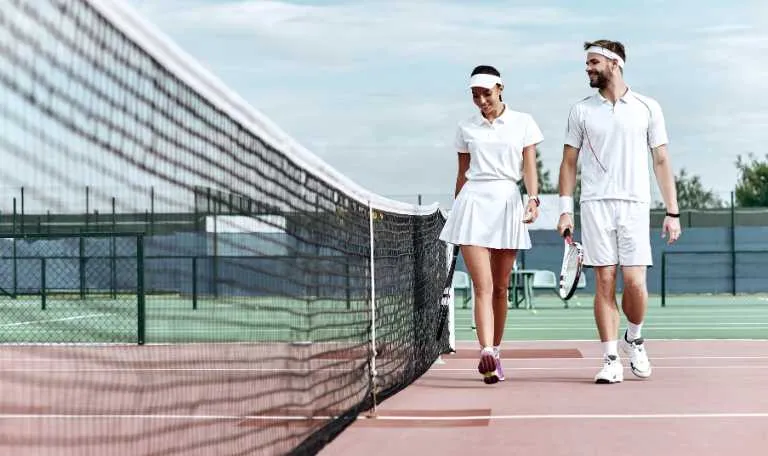
All courts will need a net, and even these seemingly “background” elements vary in cost and materials. The tennis net has a height of 36 inches in the center and 42 inches at the posts. The cost differs based on the mesh of the net. They are mostly made of braided polyethylene, which provides stability.
Once the tennis court floor is installed you will need to paint the lines on the tennis court. Line painting is a small cost item in the overall budget, but nevertheless, it needs to be done. Typically tennis court painting cost ranges between $250 and $650 depending on where the tennis court is located.
Depending on the geographical location of your tennis court construction site, you may want to consider installing a tennis court canopy or tennis air dome above the playing surface to protect the players and the tennis court from the elements. If you are building a tennis court in the southern states you might want to protect your players from the sun and heat. The low cost of a tennis court canopy and its ease of installation & removal might be your best bet.
On the other hand, a tennis air dome might be the most suitable option if you are installing a tennis court somewhere in the north. It allows you to extend the season of an outdoor tennis court facility while keeping the players warm and dry during the cold winter months. A tennis dome gives you also the added benefit of being able to take it down for the sunny season so that the users of your sports facility can enjoy playing tennis outdoors. They don’t come cheap though. Typically the cost of a tennis air bubble installed ranges between $1,400,000 and $2,900,000. The heavy price tag needs to be contrasted against the increased revenue coming from the extended days and months of use vs. a normal outdoor tennis court.
LED lighting is essential for tennis courts
LED lighting is essential for tennis courts, especially for evening or indoor play, as it provides bright, uniform illumination, enhancing visibility and playing experience. LED lights are energy-efficient and have a longer lifespan, which, while beneficial in the long term, can add to the initial installation cost. This cost increase is due to the higher price of LED fixtures compared to traditional lighting solutions and the potential need for specialized installation to ensure optimal lighting distribution and reduced glare. Despite the higher upfront cost, LED lighting is a valuable investment for its efficiency and quality, contributing to the overall cost of tennis court installation.
Read more about LED tennis court lighting costs in our separate article.
Choosing a tennis court construction company
Choosing the ideal tennis court installer involves several key considerations:
- Experience: Look for installers with a proven track record and expertise in various court types.
- Client Feedback: Check customer reviews or ask for references to gauge their reliability and work quality.
- Material Quality: Ensure they use durable, high-quality materials.
- Compliance with Standards: The installer should adhere to professional and safety standards.
- Cost: Get detailed quotes to match your budget, but be cautious of unusually low prices.
- Warranty: Opt for installers who offer a warranty and after-service support.
- Customization: Choose someone who offers customization options and thorough consultation.
- Professionalism: Consider their professionalism and commitment to timelines.
Grants and funding programs for tennis courts
To find grants and funding for tennis court projects, investigate local and national sports organizations, like the United States Tennis Association (USTA), which often provide funding for such facilities.
Additionally, explore state and local government programs, as well as community development organizations, for potential support. Private foundations and corporations may also offer grants, especially for projects promoting community health and youth sports. Utilizing online research, networking within the industry, and contacting local sports departments can unveil more funding opportunities.
We have also written about tennis court grant and funding programs in our separate article.
Calculate tennis court installation costs at an early stage
In conclusion, understanding the costs involved in tennis court construction is crucial for anyone looking to build or renovate a tennis facility. Throughout this article, we’ve explored various factors that influence these costs, from the choice of surface material to the size and location of the court, as well as additional features like lighting and fencing.
It’s clear that while constructing a tennis court is a significant investment, careful planning and consideration of these factors can help manage the budget effectively. Whether for a high school or a college, a community center, or a professional sports club, a well-constructed tennis court can provide years of enjoyment and health benefits, making it a worthwhile investment. As the game of tennis continues to grow in popularity, the demand for quality facilities will also rise, underscoring the importance of informed planning and budgeting in tennis court construction.
Meet the SVC Experts
Edited by: Antti Rydman, Managing Editor
Antti Rydman is a Co-Founder and the Managing Editor of Sports Venue Calculator. A member of the founding team, Antti has led editorial operations since 2021, shaping the platform’s content strategy and overseeing its growth as a trusted resource for sports facility planning and construction.
Read more about Antti.
Verified by: Karianne Jaeger, Construction Project Manager
Karianne Jaeger is a Project Manager with 16 years in commercial construction, specializing in sports facilities. At Beaver Construction Consulting Inc., she partners with architects, engineers, and city planners to ensure smooth permitting, compliance, and project delivery.
Read more about Karianne.
FAQ: Tennis Court
Construction Cost
Resurfacing an existing hard court in structurally sound condition typically costs 30–60% less than a full new hard court build. If the base has significant cracking, drainage failure, or sub-base deterioration, resurfacing without addressing the underlying issues will not produce a lasting result. A professional condition assessment before budgeting is strongly recommended to avoid spending on a resurfacing that fails prematurely.
Resurfacing an existing hard court in structurally sound condition — cleaning, crack repair, and applying a new acrylic coating with line markings — typically costs 30–60% less than a full new hard court build. If the base has significant cracking, drainage failure, or sub-base deterioration, resurfacing without addressing the underlying issues will not produce a lasting result. A professional condition assessment before budgeting is strongly recommended to avoid spending on a resurfacing that fails prematurely.