Antti from Sports Venue Calculator sat down with Alexis Curtenaz, Business Development Manager for SMC2 North America, to learn more about the French company bringing timber and tensile membrane sports structures to the North American market.
From Civil Engineering to Sports Construction
When we asked Alexis Curtenaz how he ended up in sports facility construction, he laughed. “Pretty much like a lot of people,” he says. “I loved playing Legos when I was a kid, did some studies in civil engineering, some carpentry, some masonry, and finally ended up at SMC2.”
That was over ten years ago. He started in the design office, working on development projects for play areas and sports structures, before moving into business development. In 2019, a personal reason brought him to Montreal, where he now leads SMC2’s commercial efforts across the U.S. and Canada.
We asked him what the move was like. “I love Montreal,” he says. “I like the city, the vibe, the atmosphere. It’s much less stressful than France, or maybe even Europe in general.” Two kids later, he is firmly rooted in North America and spending most of his time helping facility owners on this side of the Atlantic discover a building approach most of them have never seen before.
A European Company in a North American Market
SMC2 is headquartered near Lyon, France, with offices in Montreal, Frankfurt, and London. The company has been designing and building timber and tensile membrane sports structures in Europe for over 20 years. Bringing that approach to North America has required significant adaptation.
“The first thing is the culture,” says Curtenaz. “And by culture, I mean the overall ecosystem, everything that is particular to North America, even the differences between Canada and the U.S. The climate, the habits, the way of life, the comfort expectations.”
Regulatory differences add another layer of complexity. European building codes, while spread across many countries, are relatively unified in their approach. North America, despite being fewer jurisdictions, presents a more fragmented regulatory landscape, with state and provincial codes that each carry their own requirements.
“From an outside point of view, it seems like North America could be similar to Europe,” he says. “But in many places you have hurricanes, snow loads that are much bigger, tornadoes, earthquakes. All of that applies to the buildings, and we have to adapt our structures to these specificities.”
📹 Watch the full interview with Alexis Curtenaz below.
What SMC2 Actually Builds
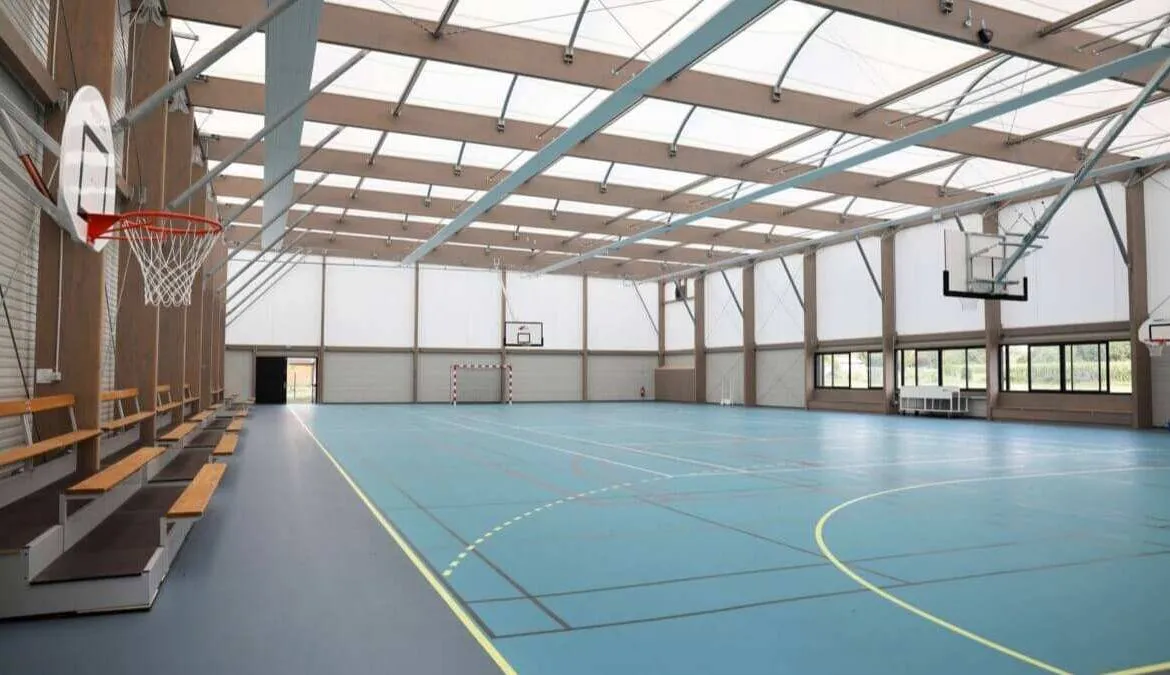
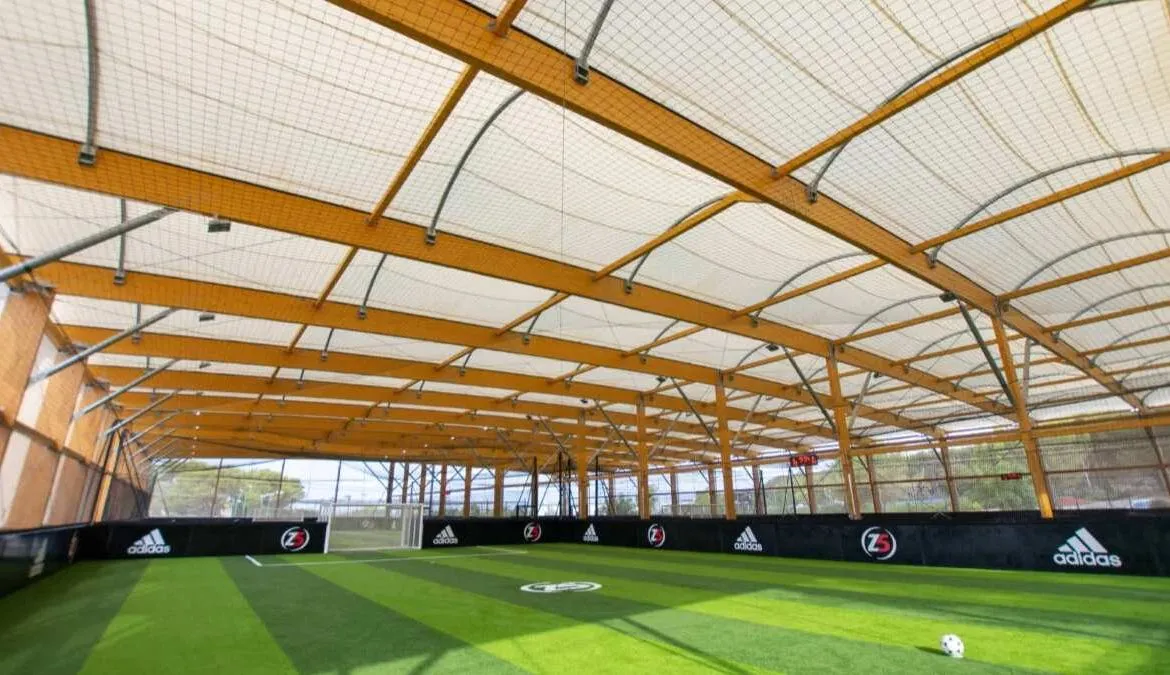
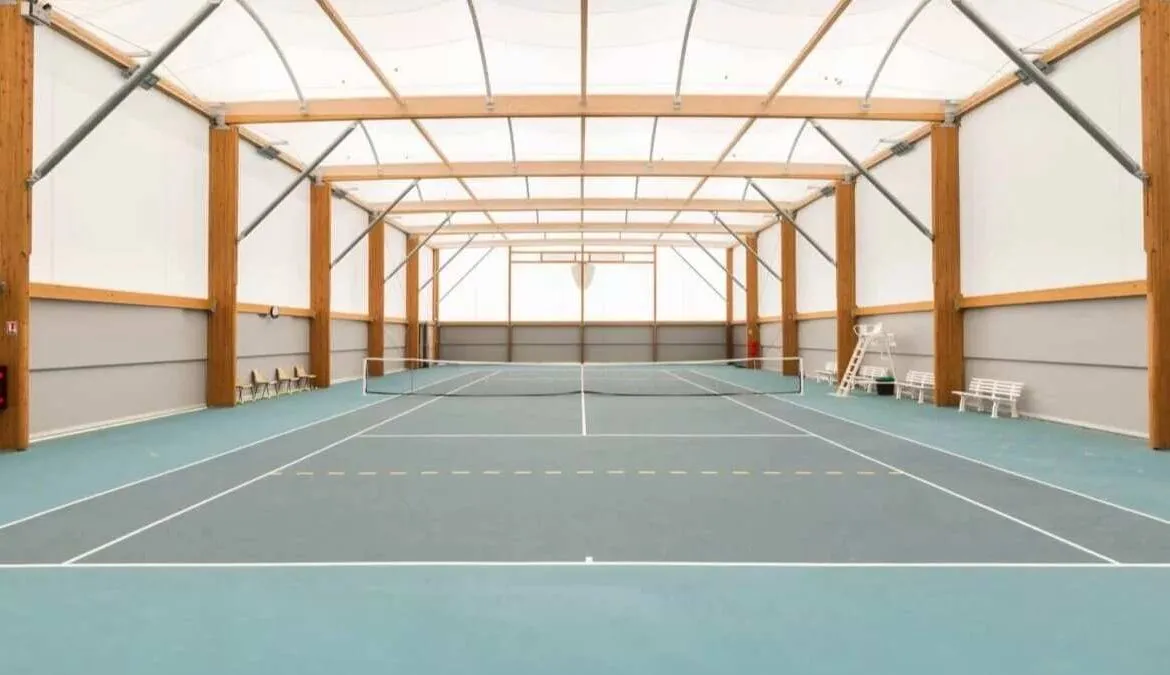
SMC2 specializes in permanent sports structures combining glulam mass timber with tensile fabric membranes. The result is a building type that looks and feels fundamentally different from conventional steel or concrete construction. Clients don’t always know what to make of it at first.
“Some like it immediately,” says Curtenaz. “Some need to be convinced. It depends a lot on who you’re speaking with, their background, where they’re from, the local climate.”
The materials each bring specific advantages. Timber is warm, aesthetically distinct, and crucially, a carbon-sink material. When mass timber is installed in a building, the carbon stored in the wood stays there, effectively removing CO2 from the atmosphere for the life of the structure.
“You cut the tree, the carbon stays in it. When you install it in a building, it’s actually going to last longer than if you left the tree to die in the forest,” says Curtenaz. “That’s why we call it a carbon sink.”
The tensile fabric membrane serves a different purpose. It is extremely lightweight, requires far less energy to manufacture than steel or concrete, and its translucency allows natural light to fill the building throughout the day, reducing the need for artificial lighting and significantly lowering HVAC loads compared to traditional enclosed structures.
“For training, for recreation, even for lower-level competition, most of the year you have enough natural light with the translucent roof and walls,” he says. “And because it creates a temperate atmosphere inside, the HVAC you need to control comfort is much reduced compared to a traditional building.”
Who Knocks on SMC2's Door
SMC2’s client base in North America spans a wide range of facility types and owner profiles. Private developers building their first padel or tennis club are a growing segment, driven in part by the surge in racket sports participation across the continent. Municipalities and public departments are regular clients, as are universities and colleges, where sport facilities are a meaningful part of campus life and institutional identity.
Architects are also a notable source of inquiries, drawn by the visual and technical distinctiveness of the building system.
“Architects are very curious about what we do and how we do it,” says Curtenaz. “We get quite a few requests just from architects.”
The sports covered range from padel and tennis to soccer, multi-sport facilities, and sports canopies. The common thread is a client who wants something that performs well, looks different, and lasts.
Sustainability: Still Catching Up in North America
In Europe, sustainability is now a baseline requirement on most construction projects. In North America, the picture is more nuanced, and Curtenaz has watched the shift happen in real time since arriving in 2019.
“At first it was only in certain locations with certain types of clients,” he says. “Now it’s more and more diverse, more and more everywhere.”
But there is a key difference in how sustainability is weighted on either side of the Atlantic.
“In Europe, sustainability is the number one criteria,” he says. “In North America, I would say it’s efficiency. The first thing a project has to be is efficient. If it’s also eco-conscious, that’s even better. But if it’s not efficient, it’s not going to work.”
It is a pragmatic observation, and one that shapes how Curtenaz positions SMC2’s offering in conversations with North American clients. The environmental credentials matter, but they follow the performance argument, not lead it.
How a Project Actually Works
For a North American client engaging SMC2 for the first time, the process starts with a conversation, not a catalogue.
“The first thing is to understand the client’s needs, his vision, his challenges, his obstacles, his team, his ecosystem,” says Curtenaz. “Once we get that, we can propose solutions based on our building system and materials.”
From there, SMC2 produces a preliminary study covering concept drawings, renderings, site integrations, and a pre-engineering calculation that allows for an accurate cost estimate. The quote that follows includes not just SMC2’s scope, which covers the design and supply of the structure, roof, and facades, but also a clear breakdown of what falls outside that scope, such as foundations, excavations, electrical, and sports equipment.
“We show it all in the quote so the client knows what is included and what to consult next,” says Curtenaz. “Later he can compare apples to apples with other proposals.”
Because SMC2 does not have licensed structural engineers in every U.S. state and Canadian province, the company completes all engineering in-house and then has the drawings reviewed, validated, and stamped by a local partner engineer. Once permits are approved, production begins in Europe, equipment is shipped to the site, and SMC2 sends a supervisor to oversee installation by local partners.
“We always send a supervisor because our building system, mixing timber and tensile fabric, can be quite specific,” he says. “We know how to erect it, we provide all the installation plans and processes, and then we support the local team through the whole installation.”
What SMC2 Offers That Others Simply Cannot
When asked what sets SMC2 apart from local North American contractors, Curtenaz points to a combination of factors that are hard to replicate individually and nearly impossible to replicate together.
“We propose a completely different approach to sports construction,” he says. “Natural light, a different atmosphere, different comfort, a different aesthetic. We don’t want to build something that looks industrial. We want something you want to come into and have fun playing in.”
Beyond the product itself, SMC2’s European general contracting background gives the company a full-project perspective that goes well beyond its supply scope in North America. The team has managed design, engineering, production, installation, and post-completion maintenance on hundreds of projects across the continent.
“Even though in North America we are a vendor only, our background allows us to have a really global view of the entire project,” says Curtenaz. “We can help clients understand what else they need, who to consult, and how to make the whole thing work, from the early concept phases all the way to delivery.”
SMC2 has been a member of the American Sports Builders Association for over three years and attends the annual show as a way of building presence and relationships within the North American sports construction community.
Learn More About SMC2
SMC2 is listed in the Sports Venue Calculator supplier directory, where facility planners can learn more about their structures and get in touch with Alexis directly. You can also visit the SMC2 website for the full project portfolio and product offering.
Planning a sports dome, tensile structure, or covered facility? Use our free cost calculator to get an instant estimate and connect with suppliers like SMC2 who can help bring your project to life.