Antti from Sports Venue Calculator sat down with Steve Pizzi, General Manager of SMG Machines USA, to learn more about the company behind some of the most recognized machinery in the sports field construction and maintenance industry.
From the Sidelines to the Machine Room
Steve Pizzi didn’t take the traditional path to running a sports equipment company. For nearly 25 years, he worked in collegiate athletics, managing facilities and events at schools like Villanova University and the University of Colorado, coordinating everything from 50,000-person football games to major capital renovation projects.
“The capital projects piece was really one of the most rewarding parts of my career,” he says. “Working with engineers and architects, understanding specifications, and then seeing something come to full fruition — a new scoreboard, an indoor practice facility, an ice rink renovation. You got to see the impact directly.”
After leaving collegiate athletics, Pizzi joined a New England-based turf contractor, where he ran their synthetic turf maintenance division and sharpened his sales skills. It was there that he became deeply familiar with SMG’s machines, running Sport Champs on a daily basis and seeing their track equipment on job sites. When the opportunity to lead SMG’s U.S. operation came up, the decision was straightforward.
“I knew the machines. I knew the reputation and the value of the brand worldwide,” he says. “When the opportunity came up, I was like, this is a real company with real brand recognition, not just here in the United States, but globally. It was a great opportunity.”
A Global Brand, Now Locally Rooted
SMG Machines is headquartered in Germany, where the company has been engineering and manufacturing sports field equipment for over 50 years. For much of its history in North America, the brand operated through a U.S. distributor, a relationship that worked well but left room for something more. In early 2024, SMG established its first direct U.S. subsidiary, headquartered in Dalton, Georgia.
The choice of location was deliberate.
“Dalton made a lot of sense for us,” says Pizzi. “It’s the synthetic turf capital of the United States. This is where the industry is. We have great relationships with the companies here, and if they need a machine, a repair, or even just a part, they can swing by. We’re here.”
That accessibility is central to SMG’s U.S. strategy. The machines may be engineered in Germany, but the support, parts, service, training, and customer relationships are now firmly on American soil.
Inside the U.S. Operation
The Dalton facility is more than an office. It functions as a fully stocked warehouse and service hub, with new machines arriving weekly from Germany to keep inventory ready for immediate deployment. Alongside new equipment, SMG also offers refurbished machines with a one-year warranty, an entry point for newer companies or those looking for a backup unit, as well as a trade-in program for customers upgrading to newer models.
The parts operation is where the local presence really proves its value. SMG’s Dalton warehouse stocks everything from small nuts and bolts to major machine components, with a clear priority on minimizing customer downtime.
“If a customer calls and says they need a part for a TCA 1400, we can ship it out that day,” says Pizzi. “They cannot stop moving. They have to keep working to be successful, and it’s our job to make sure we don’t slow them down.” For parts not immediately in stock, Germany ships directly, by air freight for urgent needs and sea freight when time allows.
The U.S. team currently consists of four people: Pizzi as General Manager, a technical service manager, a synthetic turf manager, and an administrative coordinator. A lean operation by design, with growth planned as the market expands.
“Titles are really just titles,” Pizzi says. “We’re one big team and we help each other out daily. If we’re not working as a team, we’re not helping our customers, and that’s the most important piece.”
SMG Machine Lineup
SMG’s catalog covers the full lifecycle of a sports field, from installation to daily maintenance to end-of-life reclamation, across both synthetic turf and running track surfaces.
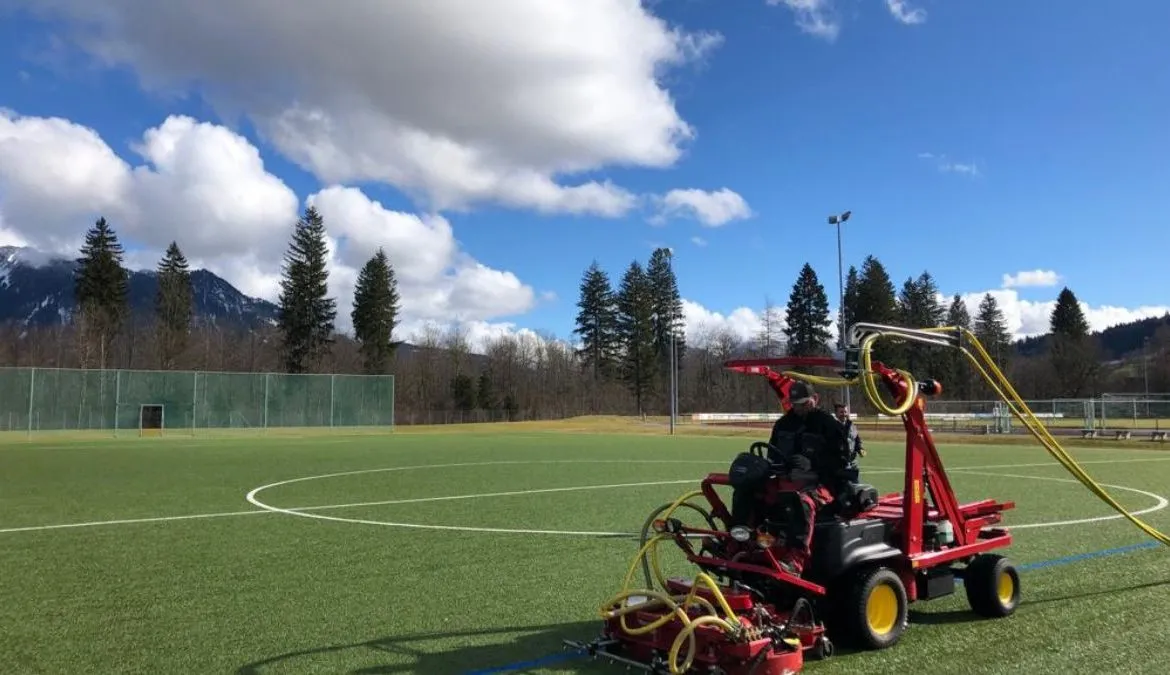
The Sport Champ is the company’s flagship machine and arguably the most recognized piece of equipment in the synthetic turf maintenance market. Designed for robust decompaction and deep grooming, it’s the tool of choice for larger facilities with dedicated grounds crews, colleges, universities, and large municipal complexes with significant turf square footage.
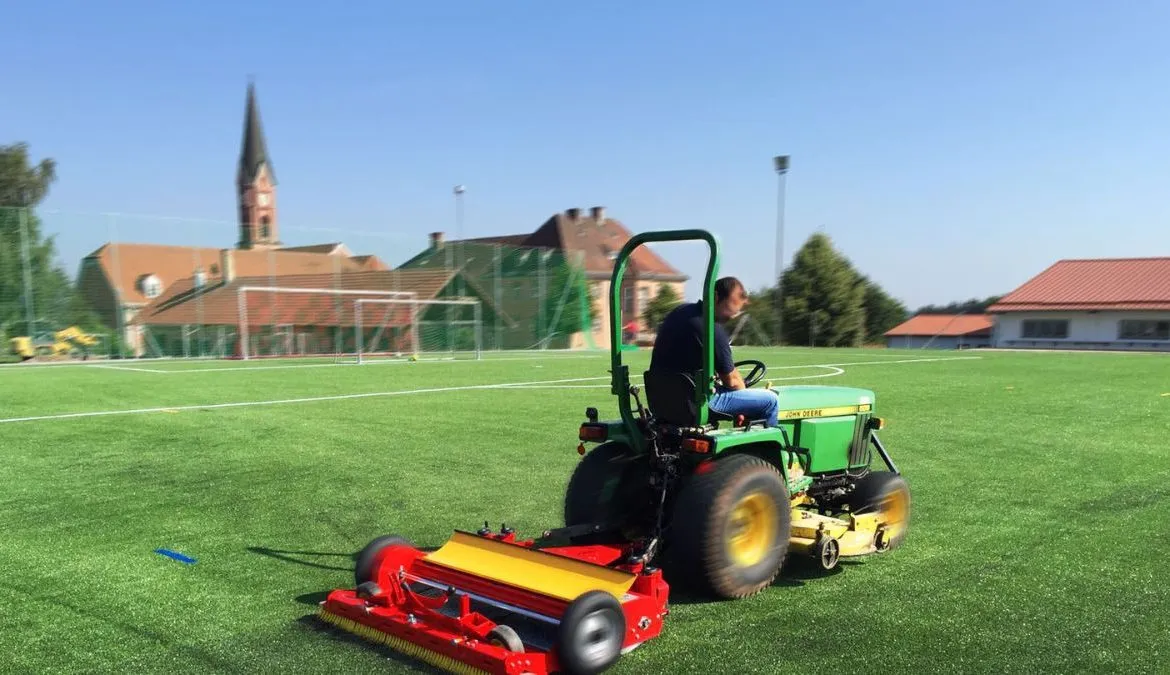
For facilities that need an all-purpose everyday solution, the TCA 1400 and TCA 2000 handle grooming, sweeping, and lining simultaneously, a practical advantage for field managers juggling multiple responsibilities with limited time. The Turf King 1502 and 1802 sit between the TCA and Sport Champ in terms of capability, offering more robust preventive maintenance for facilities that need more than basic grooming but aren’t ready for a full Sport Champ investment.
On the track side, SMG supplies the pavers, mixers, and associated equipment used by contractors to install and resurface running tracks. Custom-branded TCAs are also available for contractors who want to include a maintenance machine as part of a field installation package, a growing trend that helps contractors add value and strengthen their client relationships after the build is complete.
Why Maintenance Is Non-Negotiable
One of the clearest themes to emerge from the conversation with Pizzi is the cost of neglect. Having spent years on both the facility management and contractor sides of the industry, he has seen firsthand what happens to fields that don’t get the attention they need.
“You can tell immediately when you arrive at a facility whether they do maintenance or not,” he says. “The ones that do have a healthier, safer, and more durable surface. The turf recovers better, drainage is more consistent, and there are far fewer repairs. The ones that don’t are dealing with compacted surfaces, drainage problems, and accelerated wear.”
The financial argument is equally compelling. Deferred maintenance doesn’t just shorten a field’s lifespan, it accelerates the timeline to costly repairs or early replacement, often before the warranty has even expired. Investing in the right equipment upfront, or bringing in the right maintenance provider, is almost always cheaper in the long run.
The trend toward in-house maintenance is also growing, particularly at the school level. More and more maintenance departments are taking control of their own field care rather than outsourcing it, and SMG’s on-site training model is designed to support exactly that shift. When a new machine is delivered, the team doesn’t just drop it off.
“If you buy a piece of equipment from us and you’ve never run it, I’ll come to your first job site and spend the day with you,” says Pizzi. “I’ll show you how to run it, how to maintain it, and what parts to keep on hand for emergencies. We’re not just sales. We’re here for everybody.”
Case Study: University of Oregon
A recent project at the University of Oregon illustrates what SMG’s equipment can do in a real-world setting. The university’s recreation department manages a synthetic turf field adjacent to one of their track stadiums, a field heavily used by students for club sports and intramurals, but also regularly pressed into service as a staging area during major track events, including world-class collegiate competitions.
The problem was compaction. Tents, weights, and event infrastructure can’t be staked into synthetic turf, meaning the load bears directly on the surface, repeatedly, across multiple events each season. The result was a field that was struggling to perform the way it was originally designed to.
SMG brought in a Sport Champ for a demo. The machine’s decompaction capability was exactly what the field needed, and the university had the staff and resources to operate it effectively.
“We were able to bring a Sport Champ out, demo it for them, and they loved it,” says Pizzi. “It’s been a great partnership since then.”
What Sets SMG Apart
When asked how SMG positions itself in a market where price is always part of the conversation, Pizzi draws a straightforward comparison.
“Buying a machine is a lot like buying a house or a car. You want quality and you want value,” he says. “Our machines are engineered and built extremely well. They’re durable and long lasting. And if you’re a school or a municipality, that money is important. You’re making an investment that needs to hold up for years.”
The price point is premium, and Pizzi doesn’t shy away from that. But he points to repeat customers as the clearest validation of the value proposition. “Most customers understand it because they keep coming back, not just for another machine, but because of the value they get from the established SMG brand.”
Beyond the equipment itself, SMG positions its U.S. team as an industry resource, available to help customers identify the right machine, troubleshoot problems, and develop long-term field care strategies, regardless of whether a purchase is imminent.
“Even if someone calls just to ask a question and doesn’t buy anything from us, we help them,” says Pizzi. “We’re not just sales. We’re here for everybody.”
Where the U.S. Market Is Heading
The timing of SMG’s U.S. expansion lines up well with broader market trends. Synthetic turf installations continue to grow across schools, municipalities, and private facilities, and every new field is a future maintenance customer. The turf maintenance machine segment is where Pizzi sees the clearest growth opportunity.
“There are a lot of fields all across the United States and they need to be maintained,” he says. “We see synthetic turf machine sales increasing annually for the foreseeable future.”
The track equipment business remains strong and consistent, driven by contractor demand for installation and resurfacing projects. On the turf side, the collegiate athletics market is a particular focus, a segment Pizzi knows well from his previous career and one he sees as underleveraged for SMG’s current catalog.
Establishing the Dalton operation was step one. Step two is reaching the facility owners, field managers, and maintenance departments across the country who may not yet know that the right equipment and the support to use it effectively is now available locally.
Learn More About SMG Machines USA
SMG Machines USA is listed in the Sports Venue Calculator supplier directory, where facility planners can learn more about their products and services and get in touch directly. You can also visit the SMG Machines USA website for the full product catalog.
Planning a turf field or running track project? Use our free cost calculator to get an instant estimate and connect with suppliers like SMG who can help bring your project to life.